A $214 AI coding agent rewrite
A verified $214 bill for a production rewrite, checked against the source transcript, sits beside a corpus of about 2,900 tech talks on coding-agent costs.
Jump to summary
Written by Florian Bruniaux
AI Founding Engineer at Méthode Aristote, 13 years scaling engineering teams from developer to CTO. Builds open-source developer tools, see what else I've shipped.
TL;DR
| What | Number | Status |
|---|---|---|
| Devoxx France ticketing rewrite | $214 total, billed through the Anthropic API for Claude Code | Verified word-for-word against the raw source transcript |
| Token volume behind that $214 | Never disclosed in the source | A “210 million tokens” figure attached to this bill is a mistranscription; Martignole never says it |
| Agent cost collapse, fixed capability | Roughly 90-99%+ over about three years | Verified industry trend (a16z; Stanford AI Index 2025, data through October 2024) |
| “$7,500/hour to $20/month” for recursive agents | Flagged anecdote from a single conference talk | No independent source corroborates the pairing |
| Production token cost at real scale | Up to $500/day per developer | Birgitta Böckeler, Distinguished Engineer at Thoughtworks, aidevcon, June 2026 |
| Underlying pattern | Cheap to build, expensive to run at volume | aidevcon, March 2026 |
Nicolas Martignole, Principal Engineer at Back Market, posted a short video on October 6, 2025, pointed straight at his Anthropic billing screen. He had already put out about ten videos documenting a real rewrite: rebuilding the ticketing system for Devoxx France, the conference he organizes, using Claude Code. In this one, he sets out to answer a single question on camera, live, about how much this has cost him so far, reading numbers off a dashboard he clearly didn’t fully trust.
He starts by misreading the total: “here’s the number of tokens I used, which comes out to about $210 if I remember right” (“voilà le nombre de tokens que j’ai utilisé, ce qui représente à peu près 210 dollars si ma mémoire est bonne”), he says, before catching the billing page mid-scroll and correcting himself. Once he adds up the individual API calls by hand, the real number is $214. “To get back to the $214 I actually spent, I have to redo the math myself. Guys, please, build us something a bit simpler, a lot more readable” (“pour retrouver les 214 que j’ai dépensé, il faut refaire la somme soi-même. Les gars, faites-nous, s’il vous plaît, quelque chose d’un peu plus simple, de beaucoup plus lisible”), he tells Anthropic’s billing team directly, on camera.
$214 is the number this whole series treats as ground truth, because it is the one figure in this project checked word for word against the raw transcript rather than against an auto-generated summary of it. An earlier extraction pass over the same source material produced a line reading “Coût total de 214 dollars pour environ 210 tokens utilisés”, then a later synthesis pass rounded that into “210 million tokens” to make the ratio look plausible. Neither of those numbers exists in what Martignole actually said. He never states a token count anywhere in the video, so any token figure attached to this $214, including in an earlier draft of the research behind this series, came from an extraction pipeline and is absent from the source.
The billing mechanism explains why Martignole could produce a dollar figure at all. Anthropic gives account holders two ways to pay: a flat-price subscription (Claude Pro or Claude Max) whose usage is capped by session and weekly limits, or straight per-API-call billing, which Anthropic’s Enterprise plans can also use for usage-based seats. His Devoxx France account runs on the second option, so every prompt, every tool call, every retry Claude Code made while rewriting the ticketing system landed as a line item he could, in theory, add up. In practice, doing that math meant scrolling a dashboard and summing individual charges by hand, which triggered his on-camera complaint about needing something “a bit simpler, a lot more readable.” A metered API account is the billing setup in this series where a project’s cost is easiest to read. Most of what follows comes from teams that either can’t see that number as cleanly, or don’t like what it says once they do.
The agent cost collapse
The direction underneath Martignole’s bill is well documented outside his channel. Andreessen Horowitz’s LLMflation analysis puts the price of a fixed level of AI output performance at roughly a 1,000x drop between late 2021 and late 2024, from about $60 per million tokens for GPT-3-equivalent quality down to about $0.06. Stanford’s AI Index Report 2025 corroborates the same curve from a different angle, with data through October 2024: the cost of querying a model that matches GPT-3.5 on MMLU fell from $20 per million tokens in November 2022 to $0.07 by October 2024, a drop of more than 280x in under two years. The same report cites Epoch AI’s broader estimate that inference costs, depending on the task, fall somewhere between 9x and 900x per year. Different models and measurement windows land in the same order of magnitude. A 90-99%+ collapse in the cost of a fixed unit of AI capability over roughly three years is the verified trend. That collapse describes per-token API prices only. Subscription quotas and conditions moved the other way in 2026: The Next Web reported on September 29, 2026 that OpenAI’s ChatGPT Pro $200 plan drops from 20x to 10x the Plus allowance on October 30, 2026, at an unchanged price.
One claim from the corpus behind this series pushes that trend into far more specific, and far shakier, territory. According to a speaker at What Developers Need To Know About Agents Before 2026 (aidevcon, talk published December 30, 2025), recursive autonomous agents only became economically viable in 2025 because the cost of running them fell from $7,500 an hour to $20 a month, once model providers started shipping unlimited-usage plans. No independent source in the research for this series documents that specific pair of numbers. The direction it describes, cost per unit of agent work collapsing hard, lines up with the a16z and Stanford data above. The anchor number itself, $7,500 an hour, is a round figure whose origin the speaker does not give. Treat it as an illustrative anecdote whose anchor remains unestablished.
What production actually costs
Birgitta Böckeler, a Distinguished Engineer at Thoughtworks, in State of Play: AI Coding Assistants at AI Native DevCon in June 2026, cites some developers spending up to $500 a day in token costs once autonomous agents move from prototype into real production usage, on top of costs that don’t show up on a token invoice at all: security review, stability work, and the review debt that accumulates when code ships faster than anyone can read it.
That figure lines up with a thesis a different aidevcon talk, The Cost Nobody Budgets for When Building With AI Agents (March 2026), builds around directly. AI agents are cheap while you’re building with them, then expensive the moment real production volume shows up, and that mismatch is exactly what breaks budgets that were only ever sized against the development phase. A budget sized only against the build phase misses the running cost that arrives later.
Martignole’s $214 sits nowhere near that production reality, and the gap is a matter of scope rather than a flaw in the number. It’s the total cost of one engineer’s project: a conference ticketing system rebuilt across roughly ten videos. The video reports no production traffic figures of the kind Böckeler’s teams describe. The $214 is a solid, sourced number for what a scoped rewrite by one developer costs to build. It says nothing about what the same system would cost to run once actual attendees start buying tickets on it, and it should not stand in for that. If you want the mechanics of how a smaller decision, like which MCP servers you keep wired into an agent’s context, moves the token bill on every single call, MCP servers: what they actually cost and when to use them walks through that layer directly.
The $214 number and the $500-a-day number are both true, and they’re both real prices someone paid. They’re just measuring two completely different things: what an agent costs to build something once, and what an agent costs to keep something running. The industry-wide collapse in per-token pricing explains why the first number can be this low. It says nothing about the second, and conflating the two is exactly the mistake FinOps discipline exists to catch before it hits a monthly bill. AI velocity is bidirectional covers the twin of this problem on the code side: shipping faster with an agent also means accumulating technical debt faster, and neither speed shows up on the invoice that would make the tradeoff visible in time.
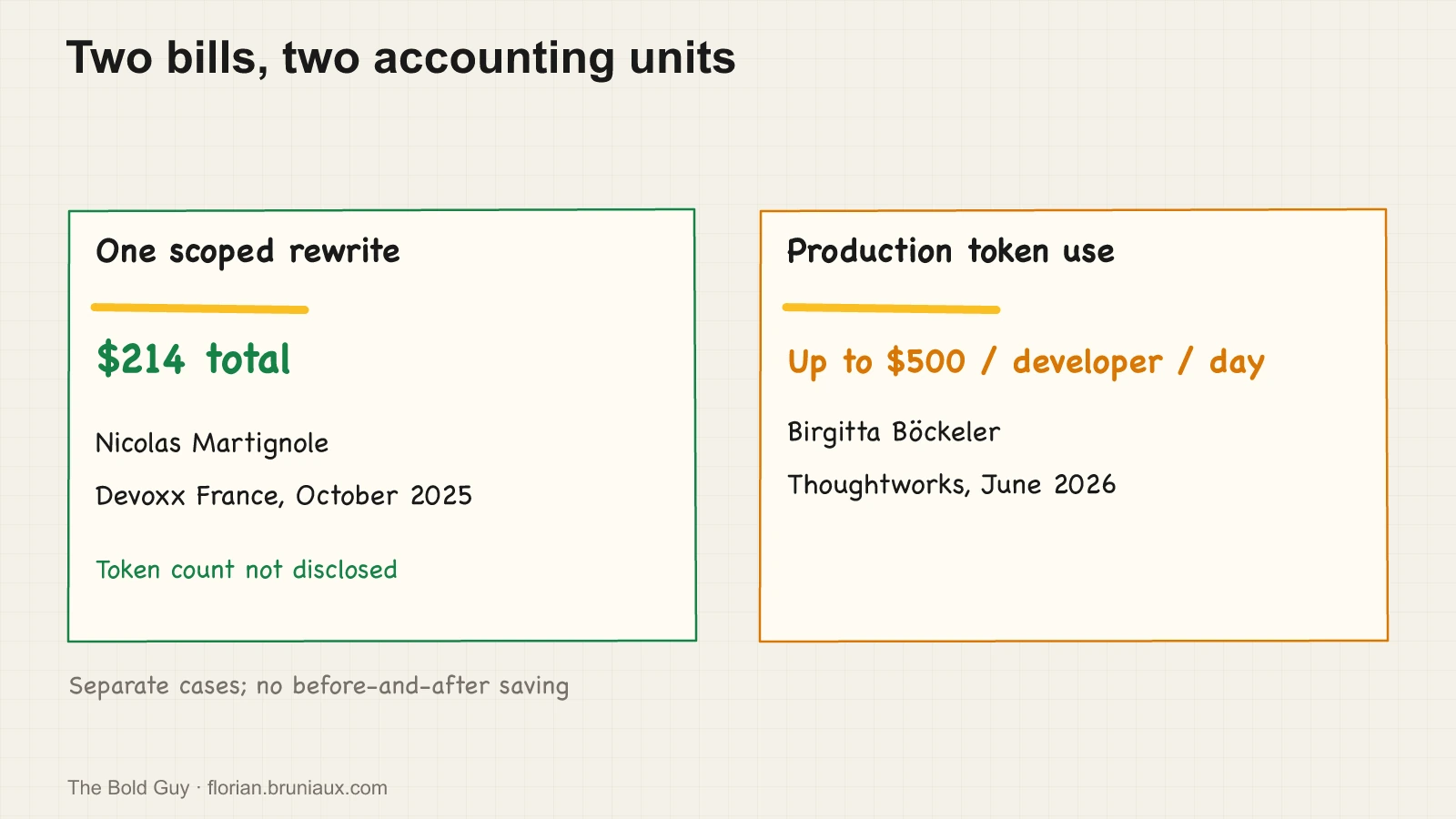
None of this settles whether the money was worth spending. $214 bought a working ticketing system. $500 a day buys a production agent nobody has fully measured the return on yet. Claude Code under the hood covers the mechanics that make a token bill move the way it does in the first place, tool calls, context window, hooks, before you ever get to the return-on-investment question. The next part in this series asks whether the money being spent on AI coding agents is paying off. The spending is real and increasingly well documented. The return is a much harder claim to verify, and part 2 explains why it is so hard to measure.
YSNK
(You should now know)
- Martignole’s $214 Devoxx France rewrite is the one figure in this series checked word-for-word against a raw transcript; any “210 million tokens” figure attached to it is a mistranscription he never said
- Per-token AI pricing collapsed roughly 90-99%+ over about three years, per a16z’s LLMflation analysis and Stanford’s AI Index 2025, independent of Martignole’s own number
- The widely-repeated “$7,500/hour to $20/month” recursive-agent claim comes from a single uncorroborated aidevcon talk. Treat the direction as plausible and the anchor figure as unverified
- Production token cost runs far past a side project’s: Thoughtworks’ Birgitta Böckeler cites teams spending up to $500 a day per developer once agents move into real production use
- Cheap to build, expensive to run is the pattern underneath both numbers, and conflating a one-time build cost with a recurring production cost is exactly the mistake FinOps discipline exists to catch
Go Further in the Claude Code Guide
Practical resources selected to help you take the next step.
Related articles
Choose your AI-assisted engineering starting path
Choose between Claude Code and Cowork, then follow the Start, Build, or Scale path that matches your role and current operating problem.
Non-technical to production in 10 days with Cursor AI
A non-developer modified 80 files in production in 10 days with Cursor AI. Exact timeline, AI config setup, and what it means for engineering teams in 2026.
Measuring your own AI usage: three meters, three different answers
Twenty days of my own Claude Code and Codex usage, measured three ways. The tools disagree by a factor of three, and dollars are not what binds.
Go deeper
Step-by-step guides that put this into practice.
Back Market a sorti 245 développeurs d'Anthropic en direct
Ce que Back Market a mesuré après 2 mois sur OpenRouter : budget par personne, choix des fournisseurs, chaîne de responsabilité. Rapport complet à lire en ligne.
Back Market moved 245 developers off direct Anthropic access
What Back Market measured after 2 months on OpenRouter: a per-person budget, a provider shortlist, a longer liability chain. Full report to read online.