Doctolib's cross-verified AI adoption data
Four conference talks and outside sources document Doctolib's AI adoption from 30 engineers to 600, without reducing it to one figure.
Jump to summary
Written by Florian Bruniaux
AI Founding Engineer at Méthode Aristote, 13 years scaling engineering teams from developer to CTO. Builds open-source developer tools, see what else I've shipped.
TL;DR
| Claim | Detail | Source |
|---|---|---|
| The headline figure | 30 to 600+ engineers equipped with Claude Code, Cursor and Copilot | Devoxx (Oct 2025) and aidevcon (Sept 2025), both talks, plus 4 sources outside the corpus |
| Engineering adoption | 60% daily active (Sept 2025, repeated at Devoxx about two weeks later), 90% daily use (Nov 2025), then broader statements covering all or nearly all engineers in 2026. The definitions differ. | Thomas Bentkowski, Product Manager at Doctolib, LinkedIn, Nov. 12, 2025; Julien Tanay, Staff SRE at Doctolib, Devoxx Paris, Apr. 23, 2026; Marco Saetta, ML Platform Product Manager at Doctolib, July 9, 2026 |
| A different Doctolib, same company | Alfred, an agent network for customer support, built to keep support costs sustainable | Goulven Le Dû, staff engineer, techready, June 2025 |
| Separate population | Dust rollout at 32% to 45%, all ~3,000 employees, a different tool entirely | Company-wide figure; the 600-person figure covers engineers |
| Meta Reality Labs version | AI-tooling community in Horizon Experiences grew over 40x in 12 months | Ian Thomas, software engineer, AI Native DevCon, June 2026 |
| Microsoft version | AI code review covers 90%+ of PRs, touches 95%+ of developers | Sneha Tuli, Principal Product Manager, aidevcon, November 2025 |
Four conference talks, four speakers who never shared a stage, and Doctolib keeps showing up in every one. Between June 2025 and February 2026, a techready case study, an aidevcon product manager, a Devoxx talk, and a TPC livestream documented different parts of the company’s AI adoption without citing each other. Overlap like that is rare in a corpus of conference recordings scattered across a year. The talks do not all corroborate the same number: aidevcon and Devoxx carry the 30-to-600 rollout, while techready (Alfred) and TPC (Health Companion) document separate initiatives inside the company, and the Dust program is a third.
Most other case studies in this series rest on a single talk or recording, a moment where a speaker said a number out loud. Doctolib offers a broader view: two talks corroborate the engineering rollout, while two more, together with the Dust program, show where initiatives and populations must stay separate.
The number that started it
At Devoxx in October 2025, a Doctolib engineering talk titled “Scaling AI Adoption: From 30 Engineers to Tech-Wide Transformation” laid out the trajectory in one line: the company went from 30 engineers using AI coding tools to more than 600, across Claude Code, Cursor and Copilot. The talk listed the friction it took to get there, quality doubts, tool availability, unfamiliarity, psychological resistance, and cost, without pretending any of them dissolved on their own.
That figure doesn’t rest on one recording. Outside this corpus, it shows up in an Anthropic customer case study, in French tech press coverage from CIO-online and Silicon.fr, and in LinkedIn posts from Thomas Bentkowski himself, the Doctolib product manager who owns the rollout. Four outside sources landing on the same 30-to-600 arc. That’s the bar the rest of this series rarely clears, and it’s why this case study earns its own part rather than a paragraph inside a bigger argument.
Four talks, four angles
Bentkowski’s own aidevcon talk, recorded September 24, 2025, carries the same 30-to-600 figure and the same 60% daily-active-user number Devoxx would repeat about two weeks later, on October 9, adding that three out of four engineers were weekly active users. What aidevcon carries and Devoxx doesn’t is the cost angle: Doctolib had started testing a local model to address both spend and footprint. Part 3 of this series already carried Bentkowski’s sharpest line from that talk, the warning that twice as many AI requests can just as easily buy twice the bugs as twice the productivity. Part 4 covered the local experiment itself, gpt-oss at 20 billion parameters, tested on narrow use cases without a measured saving reported in the talk.
A TPC livestream from February 2026 shows the product side of the same company. Axel Colin de Verdière, engineering director at Doctolib and roughly six months into the role at the time, described Health Companion, an AI layer added to the Doctolib app to turn it into a daily health companion, starting with parents. It’s a regulated healthcare product, built on generative AI, sitting on top of the same engineering org the other three talks describe from different vantage points.
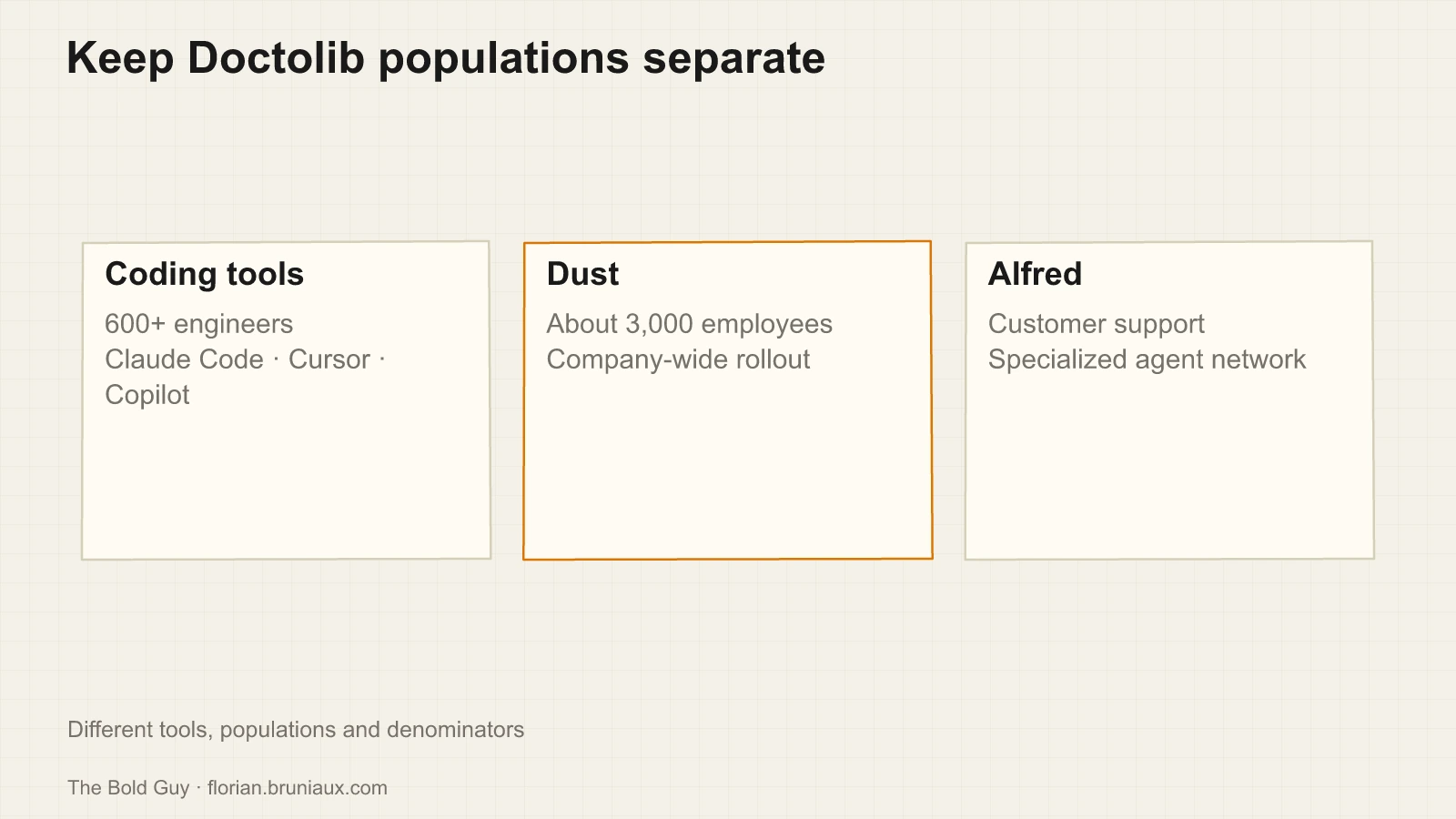
techready, in June 2025, adds a fourth and genuinely separate thread. Goulven Le Dû, a Doctolib staff engineer, presented Alfred, an agentic system built for customer support: a network of specialized AI agents that understand a request, gather the right information, and hand back a clear answer. He named the goal explicitly, keeping support costs sustainable. Alfred is a separate initiative for support staff and the customers they help; the 600-person figure covers engineers writing code. Merging the two would collapse different populations and use cases.
The 60% that stopped being 60%
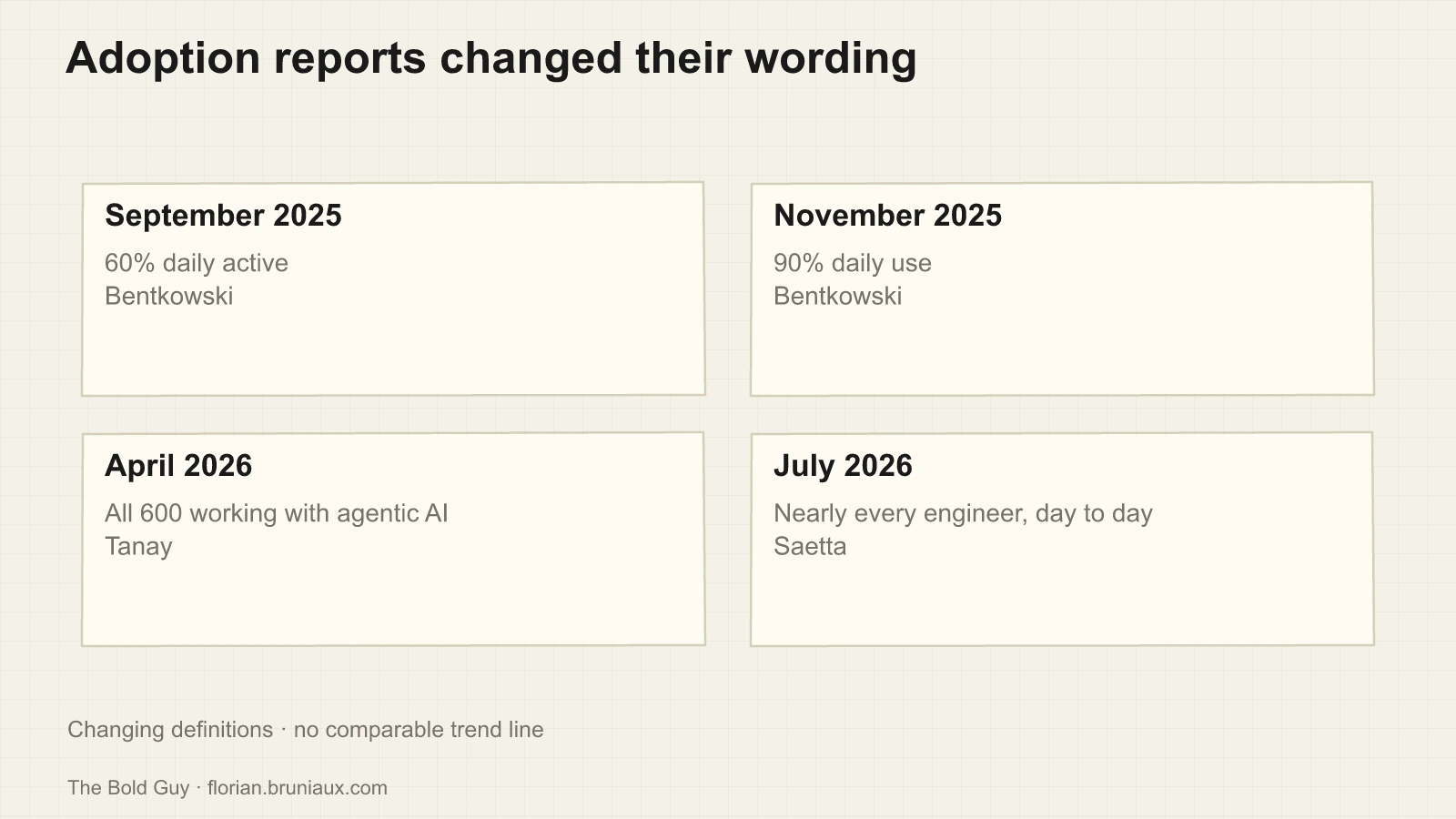
Bentkowski’s 60% daily-active-user figure is real, and it is also a single frame from September 2025. In a LinkedIn post published November 12, 2025, he reported that 90% of Doctolib’s software engineers used AI daily. At Devoxx Paris on April 23, 2026, Doctolib Staff SRE Julien Tanay said all 600 developers had been working with agentic AI since January, according to Reynald Fléchaux’s April 29 report for Le Monde Informatique. Marco Saetta, Product Manager for Doctolib’s ML Platform, later described nearly every engineer using AI day to day in a Doctolib article published July 9, 2026.
Those sources show wider adoption, but they do not form one clean daily-active-user series. Bentkowski reported daily use, Tanay described whether developers worked with agentic AI, and Saetta used a day-to-day description without publishing the underlying measurement. Treating 60%, 90% and 100% as three points from the same instrument would create a precision the sources do not support.
Doctolib also ran a program called Dust, which moved adoption from 32% to 45%. That figure describes something else entirely: Doctolib’s full headcount of roughly 3,000 people, company-wide, using a tool separate from the Claude Code, Cursor and Copilot trio the 600 engineers rely on. These are two populations and two products, and merging them into a single “Doctolib adoption rate” would misrepresent both.
Other companies also show their work
Four other companies in this corpus put a specific adoption number on the table, each traceable to one named speaker rather than an anonymous “sources say.”
Ian Thomas, a software engineer at Meta, described the community he’d helped build inside Reality Labs’ Horizon Experiences division at the AI Native DevCon in June 2026: “we grew an organic community that was over 40 times bigger than when we started,” he said, over a 12-month window that also took weekly tool usage from under half the group to over 80%. By his account the community had passed 500 people by January 2026. That’s the Reality Labs program he led at the time, not a company-wide Meta figure, an important distinction the talk itself makes clear.
Sneha Tuli, Principal Product Manager at Microsoft, put a number on AI-assisted code review in a November 2025 aidevcon talk, already cited in Part 4: “today we review more than 90% of the pull requests in the company, impacting more than 95% of the developers,” she said. Both figures are quoted from her talk.
PayFit’s figure comes from a TPC livestream in May 2026, where Nicola Carli, Senior AI Ops at PayFit, repeated the same number three separate times over the course of the conversation: more than 700 employees across France, Spain and the UK. Repetition inside one talk shows the speaker’s consistency, not outside confirmation.
Back Market’s number carries an extra layer. Nicolas Martignole, Principal Engineer at Back Market and the same Martignole whose $214 ticketing rewrite opened Part 1 of this series, spent 2021 to the end of 2023 working at Doctolib before joining Back Market in January 2024. In an April 2026 video, he described reconnecting with former Doctolib colleagues, learning they’d already rolled out Claude Code and Cursor, and finding that Back Market at the time had only Copilot and nothing else. Within months, Back Market’s own Claude Code population reached roughly 280 developers, a rollout that Doctolib’s own example, brought in by someone who lived both sides, appears to have helped kick off.
What triangulation buys you
Doctolib is the only company in this corpus documented from four separate talks and livestreams, plus four more sources found entirely outside it. Most other adoption figures in this series come from whoever happened to be on stage that day, which is the default condition of conference-talk data: someone says a number, and unless another source happens to repeat it, there’s no way to know if it’s precise, rounded for effect, or simply misremembered months after the fact.
What four independent angles buy is the ability to see where a single number would have misled. Aidevcon and Devoxx repeating “60% daily active users” within three weeks shows the number was stated consistently that autumn, although both talks come from Doctolib itself. Later sources describe broader adoption with different measurement language, so they establish direction without producing a clean time series. One talk alone would also have let Alfred’s support-cost agents blur into the same 600-engineer figure they have nothing to do with. Beyond confirming the headline number, the corroboration caught two separate ways citing it carelessly would have gone wrong: treating incompatible measurements as one curve, and mistaking one initiative for another.
Nothing here needed a research team, only four people at four events who each named their role, their company and the month they were describing. Part 2 of this series already showed how rarely anyone can put a verified number on AI’s return. Adoption figures in this series without comparable corroboration keep their single-source label and do not inherit the confidence earned by Doctolib’s 30-to-600 figure.
YSNK
(You should now know)
- Doctolib is the only company in this corpus documented from four separate talks and livestreams plus four more sources found outside it, all converging on the same 30-to-600-engineer AI adoption arc
- The 60% daily-active-user figure from September 2025 was never a stable state; later sources describe engineering-wide AI use differently and at higher levels through 2026, but the underlying measurements don’t form one clean series
- Doctolib’s Dust rollout (32% to 45% of ~3,000 employees company-wide) and its Alfred customer-support agent network are separate initiatives from the 600-engineer coding-tools figure, and merging them would misrepresent all three
- Four other companies in this corpus, Meta, Microsoft, PayFit, Back Market, each put a specific, named-speaker adoption number on the table, none anonymous
- Corroboration from separate sources is what catches the two ways citing a single number goes wrong: mistaking a snapshot for a stable state, and mistaking one initiative for another
Go Further in the Claude Code Guide
Practical resources selected to help you take the next step.
Related articles
FinOps applied to tokens: who owns the AI bill
Cloud FinOps put a cost study first and a named owner for the number second. Three practitioner cases show that sequence applied to token bills.
AI coding productivity at scale: 15-20% measured, 20x in one team
Stanford measures a 15-20% coding gain after rework. Stripe's reported 1,300 weekly pull requests show a different productivity signal.