The trillion-dollar backdrop: what markets see that teams don't
One gigawatt of AI data-center capacity costs about $50 billion. OpenAI has discussed adding up to 26, behind the series' cost figures.
Jump to summary
Written by Florian Bruniaux
AI Founding Engineer at Méthode Aristote, 13 years scaling engineering teams from developer to CTO. Builds open-source developer tools, see what else I've shipped.
TL;DR
| Claim | Detail | Source |
|---|---|---|
| The unit economics | 1 gigawatt of AI data center capacity costs roughly $50 billion | Mandeep Singh, Global Tech Research Head, Bloomberg Intelligence, Nov 25, 2025 |
| The scale | OpenAI has talked about adding up to 26 gigawatts of capacity | Same source |
| The circular deal | Microsoft and Nvidia committed up to $15 billion combined into Anthropic, tied to Azure spend and Nvidia chips | Bloomberg Tech, Nov 18, 2025 |
| Kimi K3 list pricing | $3 input / $0.30 cached input / $15 output per million tokens | Moonshot AI pricing page, read Sept. 30, 2026 |
| Kimi K3’s market shock | A Nasdaq decline reported at about 1% to 1.4% during the July 17 session | CNN, July 17, 2026 |
| The loop back | Every dollar figure in this series sits downstream of this capital | This series |
Twenty-six gigawatts, at roughly $50 billion a gigawatt, stops being a spreadsheet line somewhere past the first ten figures. OpenAI has talked about adding up to that capacity, and it is the backdrop this series has been writing about without ever naming it directly. The $214 that opened Part 1, the FinOps hires documented in Part 4 and the vendor-diversification instinct covered in Part 6 all sit inside a buildout large enough that a competitor’s release has moved a stock index.
One gigawatt, fifty billion dollars
Speaking on Bloomberg Tech on November 25, 2025, Mandeep Singh, Bloomberg Intelligence’s global tech research head, relayed the arithmetic Nvidia itself volunteered that month: content generated per gigawatt of capacity keeps growing, because, by Nvidia’s account, its chips produce the most tokens per watt of any supplier on the market. For one gigawatt, Singh said, Nvidia’s chips would account for $30 to $35 billion, his summary of two figures from chief executive Jensen Huang: about $30 billion per gigawatt for Blackwell on the November 19 earnings call, and about $35 billion for Vera Rubin in a Bloomberg interview the next day. Then Singh spelled out why that number matters: “if a 1 gigawatt costs 50 billion, any company spending 30 to 35 billion” is committing real capital, and companies including OpenAI have talked about adding up to 26 gigawatts of capacity, a scale that, in Singh’s words, “translates into huge revenue for Nvidia just from one hyperscaler.”
Twenty-six gigawatts times $50 billion runs past a trillion dollars before accounting for a single chip refresh, a single new data center site, or a single year of financing costs. That scale is why every dollar figure earlier in this series, however small it looks in isolation, sits downstream of a capital base that dwarfs it by many orders of magnitude.
The chip supplier becomes the investor
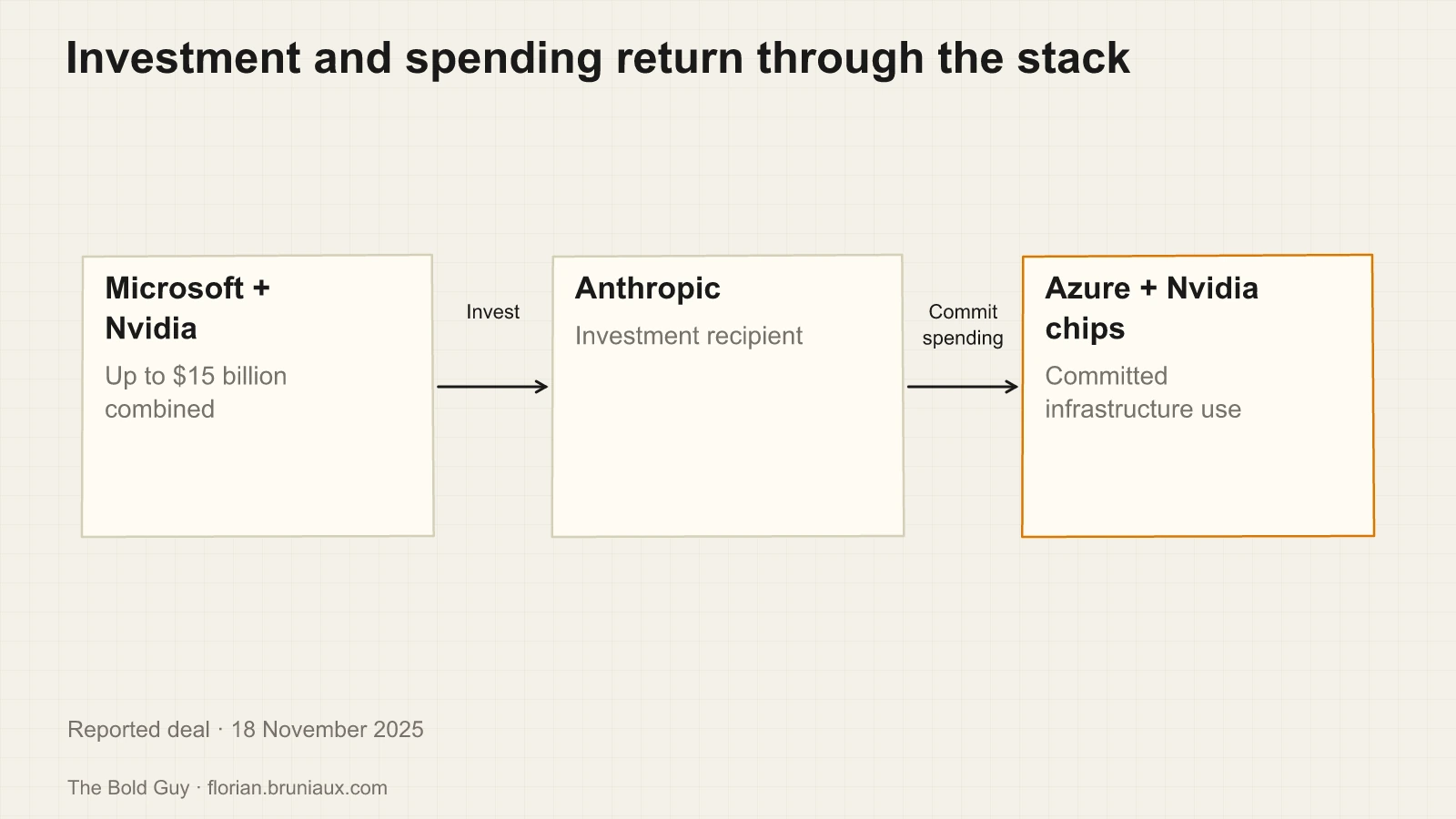
On November 18, 2025, Bloomberg Tech anchors Caroline Hyde and Ed Ludlow led with the story: Microsoft and Nvidia committing to invest up to a combined $15 billion in Anthropic, “in a move that ties the AI developer closer to two of the biggest backers of its rival, OpenAI.” One anchor summed up the structure on air: buying cloud from one company while investing equity in another is, in their words, “just more circular deals.”
Seth Fiegerman, Bloomberg’s AI editor, filled in the mechanism moments later. Anthropic, he explained, is taking money from Microsoft and Nvidia, then committing to spend that money on Microsoft’s Azure platform, using Nvidia’s chips to run the workloads. “Kind of textbook,” he called it. CNBC reported the deal valued Anthropic in the range of $350 billion, up from $183 billion in September, citing a source close to the deal, but the mechanism is what matters here. The chip supplier becomes the customer’s investor, and the customer’s spending flows straight back to both.
That valuation kept moving fast. By May 28, 2026, six months after the $15 billion circular deal, Anthropic raised $65 billion in a Series H round at a $965 billion post-money valuation, led by Altimeter Capital, Dragoneer, Greenoaks and Sequoia Capital, reported concurrently by Bloomberg, Reuters and CNBC. That figure passed OpenAI’s own $852 billion post-money valuation from a March 2026 round, making Anthropic briefly the single most valuable private AI company on paper. The reporting cited here establishes the November deal and the May valuation, but does not isolate how much the former contributed to the latter.
This is disclosed, on the record, discussed live on a financial news broadcast by the people covering it, which is what makes it worth reading carefully rather than dismissing as a hidden trick. What it does is make every capacity number harder to read at face value, because some of the demand behind these commitments comes from companies that are also investors in the buyer, as in this deal.
A cheaper model, a percentage point, and a lot of nerves
The capex thesis had already been tested once by a cheaper competitor, well before Kimi K3. On January 27, 2025, after DeepSeek’s training-cost claims rattled confidence in Western AI spending, Nvidia lost about $589 billion in market value in a single trading day, a figure Part 6 already covers in detail. Bloomberg, Reuters and WSJ reported that session as the largest one-day market-cap loss in US stock market history at the time.
Eighteen months later, in July 2026, Chinese startup Moonshot AI shipped Kimi K3, a model whose provider documentation lists 2.8 trillion parameters. Moonshot’s pricing page lists $3 per million input tokens, $0.30 per million cached input tokens and $15 per million output tokens (read September 30, 2026). On list prices, that sits between Claude Sonnet 5.5 ($2 input, $10 output) and Claude Opus 5.5 ($4 input, $20 output) on Anthropic’s pricing page, read the same day. Moonshot released it shortly before the World AI Conference in Shanghai. CNN reported a Nasdaq decline of about 1% to 1.4% during the July 17 session as the model rattled technology stocks. The episode echoed the DeepSeek sell-off, which had turned on whether planned AI capacity would earn its cost.
The comparison also cuts the other way. The provider describes Kimi K3 as an open-source model. Evaluating its hosted API against self-hosting requires checking the available artifacts and licence, hardware requirements, current token and cache prices, and cost per accepted task. List prices alone do not show that it undercuts current frontier models, as the comparison above shows for Sonnet 5.5. For the FinOps teams described in Part 4, which screen cheap-model calls before the expensive model sees them, it is another routing and hosting option to evaluate.
What the earlier parts already told you
Read back against this backdrop, the earlier parts of this series stop looking like isolated stories about individual teams and start looking like local decisions made in the shadow of a capital base three of them never mention directly. Part 1’s $214 ticketing rewrite ran on infrastructure paid for by exactly the kind of capex this part describes. Part 4’s FinOps discipline, cloud FinOps applied to tokens, exists because someone at scale had to answer for spending that traces back, however indirectly, to gigawatt-scale commitments and the vendors racing to fill them. Part 6’s argument against single-vendor dependence reads differently once you know that the vendors themselves are cross-investing in each other: diversifying away from Anthropic alone does not diversify away from the Microsoft-Nvidia capital that increasingly sits behind Anthropic too.
The other four parts sit in the same position. The ROI measurement problem in Part 2, the productivity-versus-hype gap in Part 3, the token-pricing thesis in Part 5, and the four-source triangulation on Doctolib in Part 7 all describe decisions made by teams operating several layers removed from the capital that makes their tools possible in the first place. A $214 receipt and a 26-gigawatt commitment sit on the same capital chain, nearly ten orders of magnitude apart.
That gap between scales is also the honest limit of this series. The figures in Parts 1 through 7 were checked against raw transcripts where those transcripts were available, but several speakers remain anonymous or only partially identified. Nicolas Martignole supplies central evidence in Parts 1, 5 and 6, while Part 7 draws on four separate Doctolib talks. Part 9 is a different case: it reports one person’s own measured usage, checked against a second counting implementation. The capex figures in this part come from the same checking discipline, but they describe a market few of those practitioners can act on directly. A FinOps lead can renegotiate a contract. Nobody at that level moves a 26-gigawatt commitment.
Meta has pledged more than $600 billion in US investment through 2028, an envelope its CFO described as covering data centers and the operations behind its US business, staff included, not a capex forecast. Part 4 documents routing and model substitution at team scale; the corpus does not establish whether those controls can materially alter spending on that scale.
YSNK
(You should now know)
- One gigawatt of AI data center capacity costs roughly $50 billion, and OpenAI alone has talked about adding up to 26 gigawatts, a capital base north of a trillion dollars before a single chip refresh
- Microsoft and Nvidia committed up to $15 billion combined into Anthropic in November 2025, tied to Azure spend and Nvidia chips, the kind of arrangement Bloomberg’s anchors called “circular deals”
- Six months after that deal, Anthropic raised a Series H at a $965 billion post-money valuation, which put it ahead of OpenAI’s $852 billion on paper
- Cheaper competitors keep testing whether this capex thesis holds: DeepSeek’s January 2025 release cost Nvidia about $589 billion in market value in a day, while Kimi K3’s July 2026 release coincided with a reported Nasdaq decline of about 1% to 1.4%; coincidence does not isolate the model’s effect
- Every dollar figure in this series, Martignole’s $214 receipt included, sits downstream of this capital base, many orders of magnitude removed from any single team’s control over it
Go Further in the Claude Code Guide
Practical resources selected to help you take the next step.
These resources provide adjacent lenses. They are not maturity stages.