You cannot depend on a single AI vendor
A $589 billion single-day stock rout, an enterprise model platform, and a €25,000 backup server show three scales of vendor dependence.
Jump to summary
Written by Florian Bruniaux
AI Founding Engineer at Méthode Aristote, 13 years scaling engineering teams from developer to CTO. Builds open-source developer tools, see what else I've shipped.
TL;DR
| Claim | Detail | Source |
|---|---|---|
| The rule | You cannot depend solely on Anthropic and Claude Code | Nicolas Martignole, Principal Engineer at Back Market, July 2, 2026 |
| The evidence trail | Multi-provider benchmark via OpenRouter, then a full thesis on why the sticker price misleads, then a legal split between Claude Max and the API | Martignole, June 30 to July 22, 2026 |
| The sovereignty backstop | A €25,000 self-hosted server running a Chinese open-weight model, kept as a plan B in case access is cut off | Martignole, interview with Prompt Humain, July 24, 2026 |
| The market’s version of the same risk | Nvidia lost $589 billion in market capitalization in one trading day, reported as the largest single-day loss in US stock market history at the time | Bloomberg, Reuters, WSJ, January 27, 2025 |
| The contested cost claim behind it | DeepSeek’s own technical report cites $5.576 million for V3’s final training run; R1 is outside that figure’s scope, and independent estimates put real capex near $1.6 billion | DeepSeek technical report; TechCrunch, CNBC, SemiAnalysis, January-February 2025 |
| Same rule, bigger scale | A sovereign model-as-a-service pattern for enterprises, France’s state AI platform, and a gambling company’s forced multi-datacenter rebuild | Devoxx 2026, DINUM (French state), Devoxx Greece 2025 |
Nicolas Martignole was two minutes into explaining a cost curve when he dropped the actual point of the video. Back Market had just spent four weeks getting its AI spending back under control after testing alternative models, and he wanted to name the mechanism before moving on. “What’s the secret? You cannot depend solely on Anthropic and Claude Code. You’re taking on too much risk, and the price against the value it generates becomes far too excessive” (“Le secret c’est quoi ? Vous pouvez pas être dépendant uniquement d’Anthropic et de Cloud Code. Vous prenez un risque trop important et les prix par rapport à la valeur qui est générée sont beaucoup trop excessifs”), he said on July 2, 2026, mid-benchmark. His channel’s auto-captions render Claude Code as “Cloud Code” throughout, a known transcription artifact, but the rule stands, and single-vendor dependence belongs on the same risk register as any concentration risk.
Part one of this series introduced Martignole as the engineer who added up a $214 Anthropic bill line by line, on camera. What he built after that project is the part that matters here: a documented habit of testing his own dependence on Anthropic, in public, on a schedule.
Three weeks of receipts
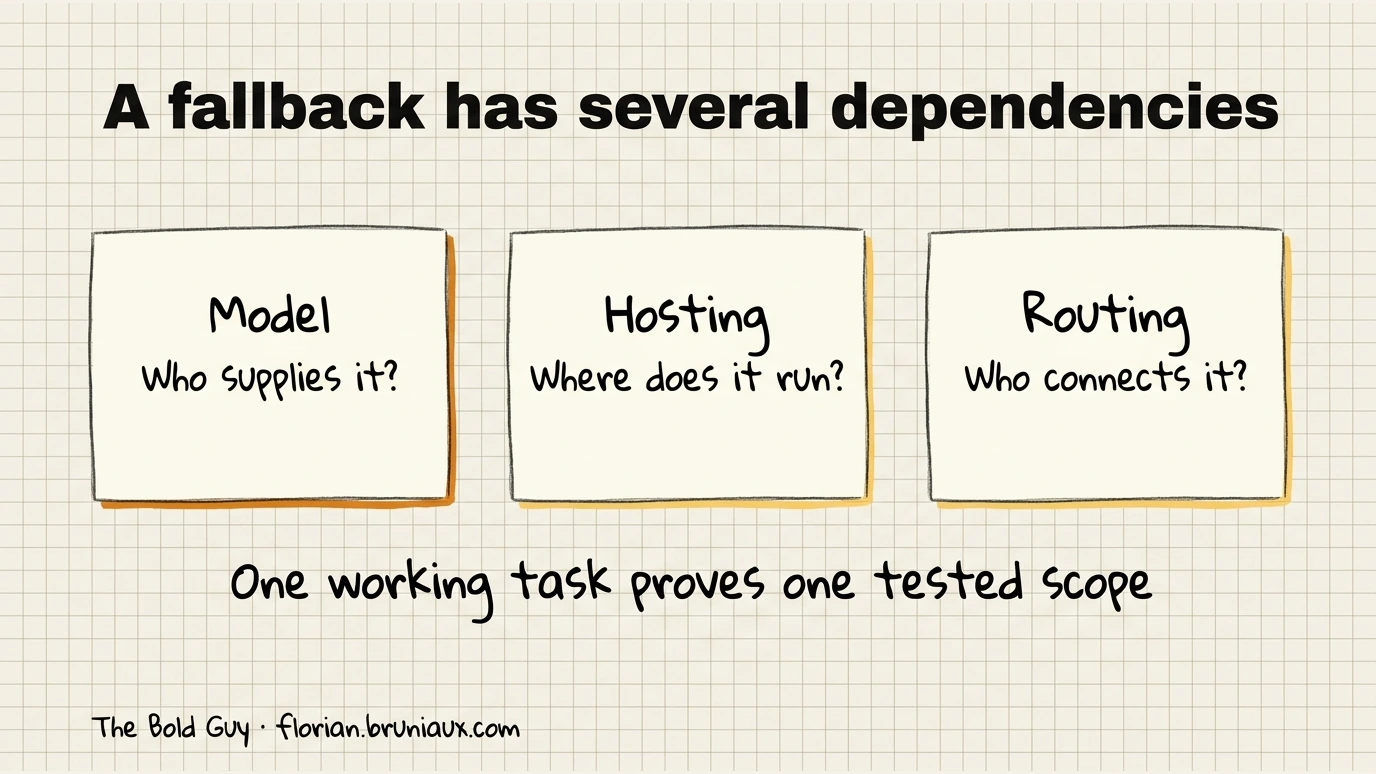
The rule didn’t arrive as a one-off opinion. Two days before he stated it, on June 30, Martignole walked through why his team was evaluating OpenRouter, a routing layer that gives access to more than 70 model providers through one contract. Separate the model supplier from the hosting and routing layers. Switching an endpoint does not necessarily replace the model supplier, and a gateway can itself become a dependency. For a company his size, cheaper tokens mattered less than the contract structure around them: one contract instead of several, one gateway instead of a dozen integrations, and the ability to route by team, model, or budget without renegotiating anything. It’s the same instinct behind the FinOps function part four of this series documented: consolidate the levers before an incident forces the question.
Nine days after the rule, on July 11, Martignole built the fuller argument out: the price a vendor lists per token barely predicts what a workload actually costs, because caching, verbosity, and the split between input and output tokens all move the real bill independently of the sticker price. Part five of this series covers that thesis in full. The relevant point here is the order these videos arrived in: multi-vendor testing first, then the pricing thesis that explains why testing matters, a sequence that reads less like a hot take and more like someone building a case file over three weeks.
Eleven days later, on July 22, he closed the loop with a distinction most teams skip past. He described Claude’s Free, Pro, and Max plans as running on one type of contract and the API, Console, Team, and Enterprise tiers on a separate commercial contract (this piece did not check Anthropic’s terms against his description). “You don’t really get a choice on price. What you actually get is a choice of legal framework” (“Vous n’avez pas vraiment un choix de prix. En fait, c’est plus un choix de cadre juridique”), he said, before naming the part that changes with the contract type rather than the invoice: in his account the two texts protect a customer’s interests differently and carry different guarantees on what happens to the data. Governance, in his framing, starts at the signature page before it ever reaches the pricing page.
The sovereignty backstop
Testing alternatives is one layer of protection. Martignole keeps a second one that never shows up in a benchmark video. In a July 24, 2026 interview with Prompt Humain, he described Back Market’s actual fallback plan if Anthropic access were ever cut or its prices spiked past what the team could absorb: “with a €25,000 server and a Chinese open-weight model, we’re seriously considering self-hosting in case access gets cut” (“avec un serveur à 25 000 euros et un modèle chinois open weight, on envisage sérieusement de s’auto-héberger en cas de coupure d’accès”). That is a modest outlay as insurance against a single point of failure. The same interview traces the earlier move from Claude Code alone to Open Code plus OpenRouter, for the same stated reason, spreading the model bill across more than one vendor before a forced migration becomes the only option. That setup runs on API keys, not on Claude subscription credentials, which Anthropic’s legal and compliance page bars third-party developers from routing through Free, Pro or Max plans. Vendor terms also moved in 2026: Anthropic announced a separate credit for Agent SDK and claude -p usage and then paused it, the Sonnet 5 increase to $3 / $15 planned for September 1 was cancelled, and The Next Web reported on September 29 that ChatGPT Pro $200 included usage falls from 20x to 10x Plus on October 30 at the same price.
The market saw the same risk, from orbit
Bloomberg covers this exact fear from a different altitude, with receipts dated January 27, 2025. Nvidia’s stock fell 17% in a single session after DeepSeek’s R1 model raised doubts about how much compute frontier AI actually requires, wiping out $589 billion in market capitalization, more than double the previous single-day record of $279 billion the company itself had set the previous September. Bloomberg, Reuters, and WSJ all land in a $589 to $593 billion range, and they reported it as the largest single-day market-cap loss in US stock market history at the time. A Bloomberg quick-take that day noted investor Marc Andreessen was already calling it AI’s “Sputnik moment.” Part 8 of this series revisits that $589 billion swing alongside the gigawatt-scale capex it was reacting against.
The number that supposedly triggered the panic needs a caveat. DeepSeek’s own technical report does cite $5.576 million for V3’s final training run, a real figure headlines routinely misapplied. R1’s distillation, the hardware, research staff, and prior experimentation that got the team there all fall outside that amount. TechCrunch and CNBC flagged this gap within days of the rout; SemiAnalysis went further and estimated DeepSeek’s actual capital expenditure at closer to $1.6 billion. The market number stands: Nvidia lost at least $589 billion in a day. The training-cost number that supposedly explained why remains contested, so citing it without the caveat misstates what is known.
Same rule, bigger scale
Martignole’s rule scales past one engineering team. A Devoxx 2026 talk on building a sovereign model-as-a-service platform, given by a solution architect in AI platform engineering, lays out the enterprise version: put an abstraction layer and a gateway in front of whichever models a team uses, keep the underlying models swappable, and treat vendor independence as a design requirement from day one. “You can’t be 100% independent, but try to be as independent as possible,” the talk’s closing advice runs, a recap built around one governance discipline, monitor everything, and one architectural discipline, keep the contract with the model separate from the model itself.
France’s own digital administration runs a public-sector version of the identical pattern. Arnaud Robin, Chief Product Officer for LaSuite at DINUM, the French state’s digital directorate, described the country’s AI infrastructure project in an April 2026 talk: a “cloud de confiance,” a sovereign, trusted cloud environment, running mutualized GPU inference that hosts multiple LLMs and lets any government administration build on top of the shared base rather than depend on a single external provider. He described the mission on camera: DINUM exists to make the state “more efficient, simpler, and above all more sovereign” through digital tools (“plus efficace, plus simple et surtout plus souverain”), with sovereignty named last and stressed most.
Novibet’s story shows what happens when this choice stops being optional. The gambling platform ran its European operations from a single data center until national regulations began requiring user data to stay within its own borders, something no single European data center could satisfy. A single data center serving many countries also concentrated risk in a different way: one network incident or cloud outage would have hit every user in every market at once. Novibet rebuilt onto a multi-datacenter architecture, keeping a centralized trading hub while spreading regional operations across borders, converting a compliance requirement and a resilience gap into one migration instead of two.
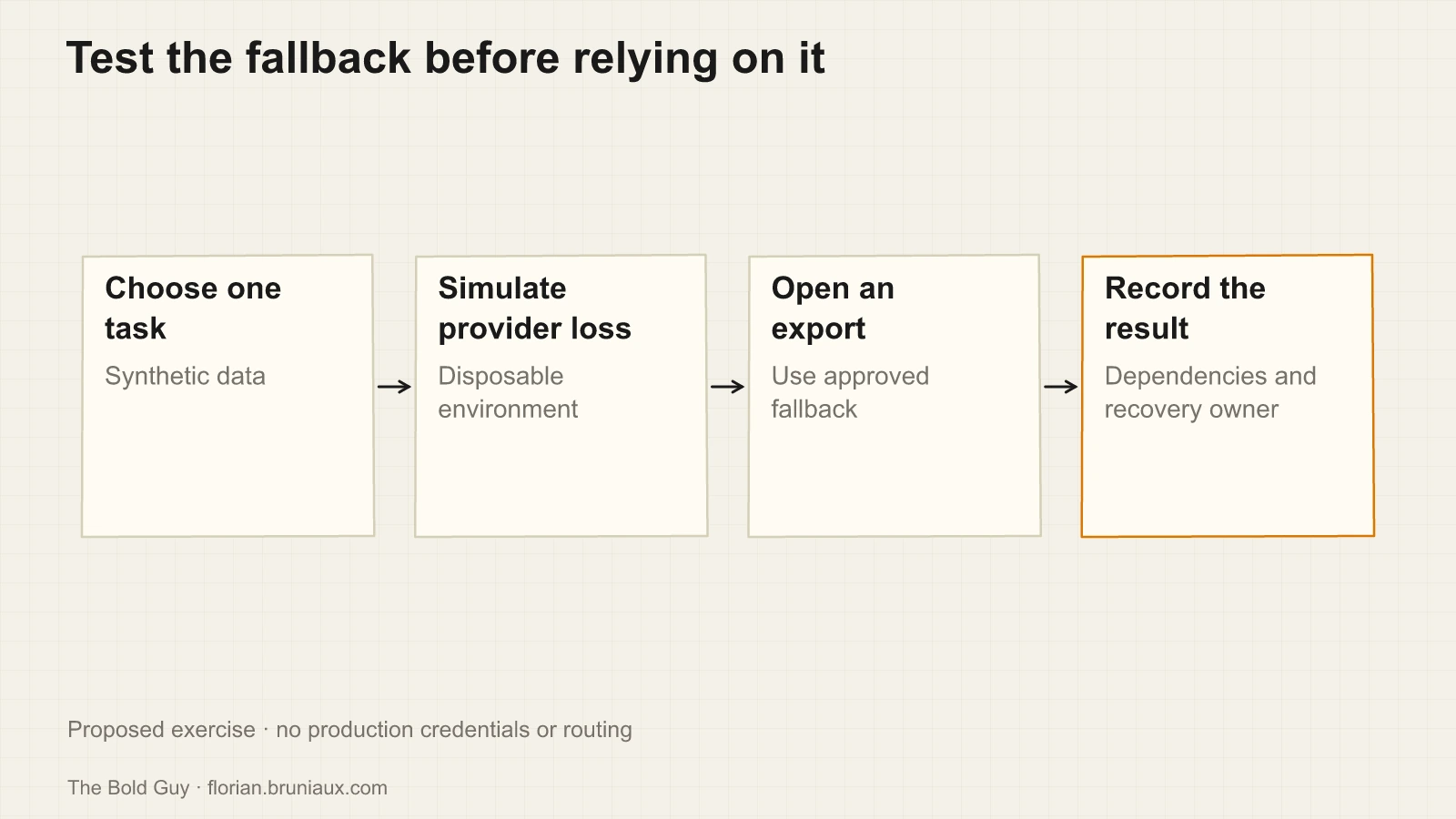
Test the dependencies behind the fallback
The IFTTD sovereignty chapter reframes part of the question around continued access to data. Owning a server or export is not enough if opening it still requires an unavailable identity provider, key service or proprietary tool.
Choose one representative task and synthetic data. In a disposable environment, simulate loss of the selected provider, open an export and attempt the task through the approved fallback. Record authentication, model, format and tool dependencies, degraded behavior and recovery ownership. Keep production credentials and routing out of the exercise.
Distinguish changing the hosting provider from replacing the model: another endpoint for the same model can reduce one dependency while retaining another. A working fallback for one task does not establish general vendor independence. The useful output is a tested scope and a list of remaining dependencies, not a sovereignty label.
Two views of the same risk
A crossover analysis of Bloomberg’s own back catalog against Martignole’s testimony shows the split: of nearly 800 Bloomberg tech recaps, 68 cover sovereignty, chip export controls, and the rise of Chinese models, framed as capital and geopolitics. Martignole covers the identical risk from inside a 320-person engineering org, where it shows up as a benchmark video, a contract clause, and a €25,000 server nobody hopes to plug in. He framed the battle in cultural and economic terms after excluding technical and generational explanations (“la vraie bataille n’est ni technique, ni générationnelle, mais culturelle et économique”). Bloomberg supplies the market-scale view; Martignole supplies one engineering organization’s view. This corpus comparison does not show how often teams act on the vendor risk they identify.
YSNK
(You should now know)
- Martignole’s rule, stated on camera: you cannot depend solely on Anthropic and Claude Code, because the concentration risk outweighs the value once the price moves
- He tested it in public over three weeks: a multi-provider OpenRouter benchmark, then the price-per-token thesis explaining why testing matters, then a legal split between Claude Max and API contracts
- His actual fallback plan is a €25,000 self-hosted server running a Chinese open-weight model, kept in case Anthropic access gets cut
- The market priced a related risk at a different scale: DeepSeek’s R1 release wiped $589 billion off Nvidia’s market cap in a single trading day, reported as the largest one-day loss in US stock market history at the time
- The same rule scales past one engineering team: France’s DINUM runs a sovereign multi-model cloud, and Novibet was forced into a multi-datacenter rebuild once single-vendor, single-location infrastructure collided with data-residency law
Go Further in the Claude Code Guide
Practical resources selected to help you take the next step.
Open-source galaxy
Projects used in this path
Related articles
FinOps applied to tokens: who owns the AI bill
Cloud FinOps put a cost study first and a named owner for the number second. Three practitioner cases show that sequence applied to token bills.
The price-per-token lie: why cheaper models don't mean cheaper bills
Opus 5.5 changes input, output and cache economics. Price the accepted task, including retries and review, before choosing a cheaper model.
Why AI ROI stays invisible, even to the people measuring it
Claims that nobody can measure AI ROI and that 95% of pilots return zero are weaker than their usual retellings, once their sources are checked.