Non-technical to production in 10 days with Cursor AI
A non-developer modified 80 files in production in 10 days with Cursor AI. Exact timeline, AI config setup, and what it means for engineering teams in 2026.
Jump to summary
Written by Florian Bruniaux
AI Founding Engineer at Méthode Aristote, 13 years scaling engineering teams from developer to CTO. Builds open-source developer tools, see what else I've shipped.
TL;DR
| What | Details |
|---|---|
| Who | Augustin, product profile, no coding background, used Lovable for prototyping |
| Goal | Contribute to production codebase at Méthode Aristote |
| Tool | Cursor (chosen over Claude Code for the visual IDE experience) |
| Day 10 | First PR in production: 80 files modified, 15 bug fixes |
| Day 21 | Multiple PRs per day within frontend work and repeated patterns; backend and security stayed with experienced developers |
| The 3 factors | Adapted AI config (-59% lines), structured architecture (3-tier, replicable patterns), measured progression |
| What it means | Contributing now requires structural understanding, not the ability to write code from scratch. |
Non-technical contributor (2026): someone with product domain knowledge and AI tool proficiency but no prior coding experience, capable of shipping to production inside an AI-assisted, pattern-consistent codebase.
December 2025. Augustin came to me with a direct request: “Train me. I want to ship to production.”
He wasn’t a developer. He’d used Lovable to prototype interfaces, but he was blocked by the actual codebase: no terminal experience, no TypeScript, no understanding of how tRPC routers connect to service layers. I’d been building the platform as AI Founding Engineer for 5 months at that point, with a configuration I’d spent evenings tuning.
My boss asked what I thought. He told me the engineering team at Cartesia (the group we belong to: experienced developers, strict TDD, people who’d been doing this for years) would have said no immediately. “That’s not how this works.”
I said: “Deal. Let’s go.”
Windows forced a different setup
First friction: Windows vs Mac
My entire workflow ran on macOS. Unix commands, shell hooks, zshrc configurations, slash commands: none of it would work on his machine. Before thinking about AI, we had an OS compatibility problem.
We benchmarked Claude Code vs Cursor for his situation. The conclusion was clear: Cursor was better adapted. Less terminal dependency, a more visual IDE experience, a UI that doesn’t require knowing what a shell prompt is.
The AI config problem
My Claude Code configuration had grown over months of iteration. By the time Augustin joined, I had a 703-line generated CLAUDE.md covering my entire setup: all 6 feature modules active, macOS environment, every MCP server configured, direct_brutal communication tone, RTK enforcement rules, the full stack.
Giving him that configuration would have been noise. The MCP server docs covered tools he wasn’t running. There was macOS shell setup for someone on Windows, and advanced debugging methodology for someone who was still learning what a file path is.
The solution was a profile system. His YAML profile produced 289 lines, compared with 703 for mine. Excluding irrelevant sections reduced the configuration line count by about 59%. This is not a measured token or billing reduction.
# profiles/augustin.yaml
id: augustin
display_name: "Augustin"
os: windows
tool: cursor
communication:
  tone: ultra_concise
modules: [] # No advanced modules, not relevant yet| Layer | Florian (703 lines) | Augustin (289 lines) |
|---|---|---|
| Foundation (shared) | Business domain, session types, user roles | Identical, always included |
| OS & tooling | macOS, zsh, RTK hooks | Windows, Cursor UI |
| Communication tone | Direct/brutal advisor | Ultra-concise |
| Feature modules | 6 active | None |
| MCP servers | Full stack configured | Excluded |
| Advanced debug | Full methodology | Excluded |
| Net result | 703 lines | 289 lines (-59%) |
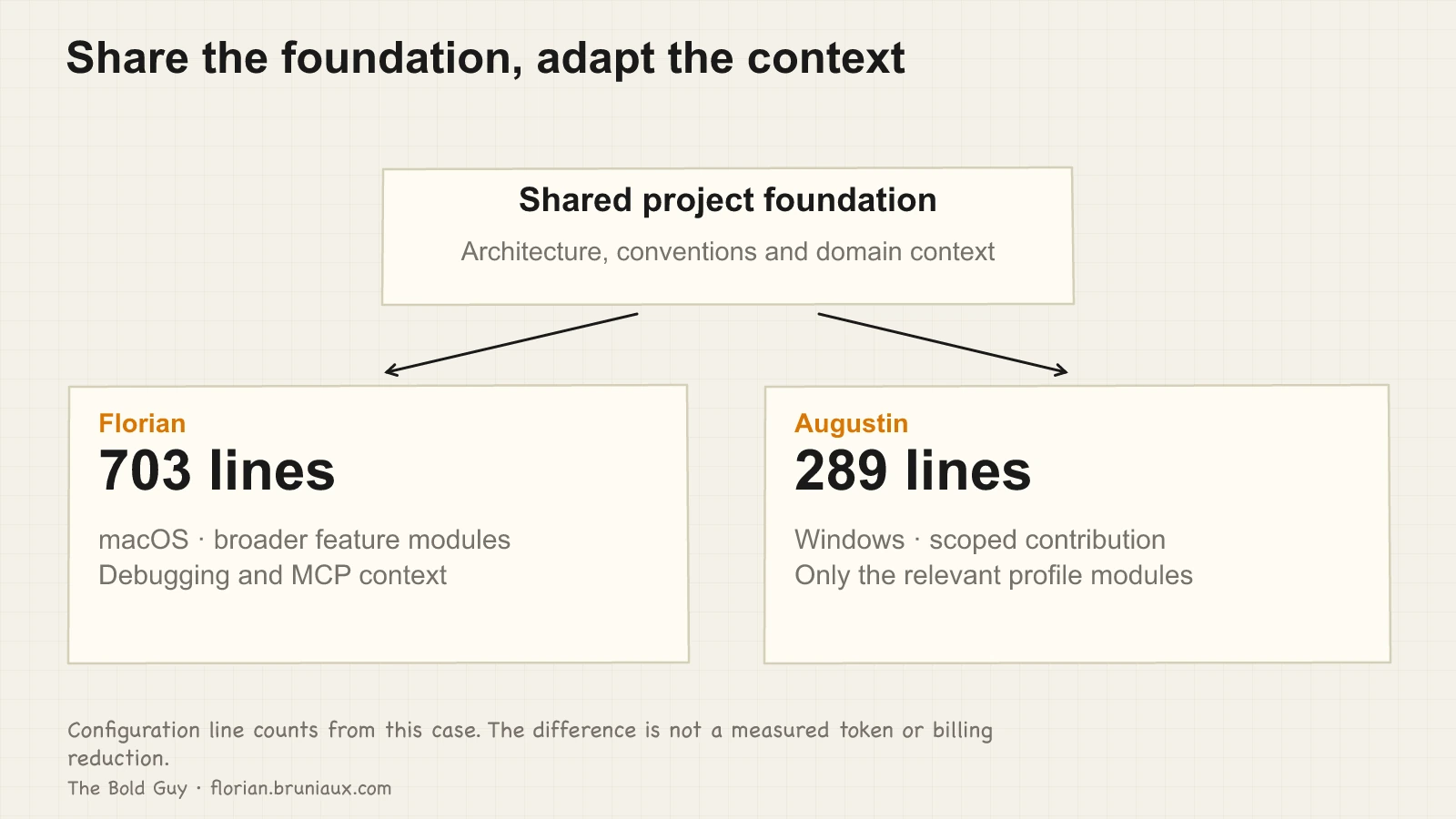
But the shorter file isn’t the interesting part. What mattered more was what was included: the business domain. The AI Augustin worked with already knew that a “session” in our codebase meant either SUPERVISED (1 hour with a tutor) or AUTONOMOUS (30 minutes solo), with a lifecycle of SCHEDULED → STARTED → COMPLETED. It knew the 15-minute tolerance rule before cancellation. It knew the 7 user roles and what permissions each carried.
That business knowledge came from the foundation layer of the config, shared across all profiles. When Augustin asked the AI to help with a bug in the session scheduling component, the AI wasn’t guessing what “session” meant. It already knew.
The AI he interacted with was calibrated for where he was, not where I was, but it carried the same understanding of what the product was doing.
The first week: iteration, not training
We didn’t do a week of sessions where I explained the codebase. We iterated daily. Hooks that didn’t work on Windows. Skills that assumed Unix paths. Cursor compatibility issues that needed workarounds. A lot of ping-pong, back and forth. It took time, but it built something: a configuration that actually worked for his setup.
From zero files to production in 10 days
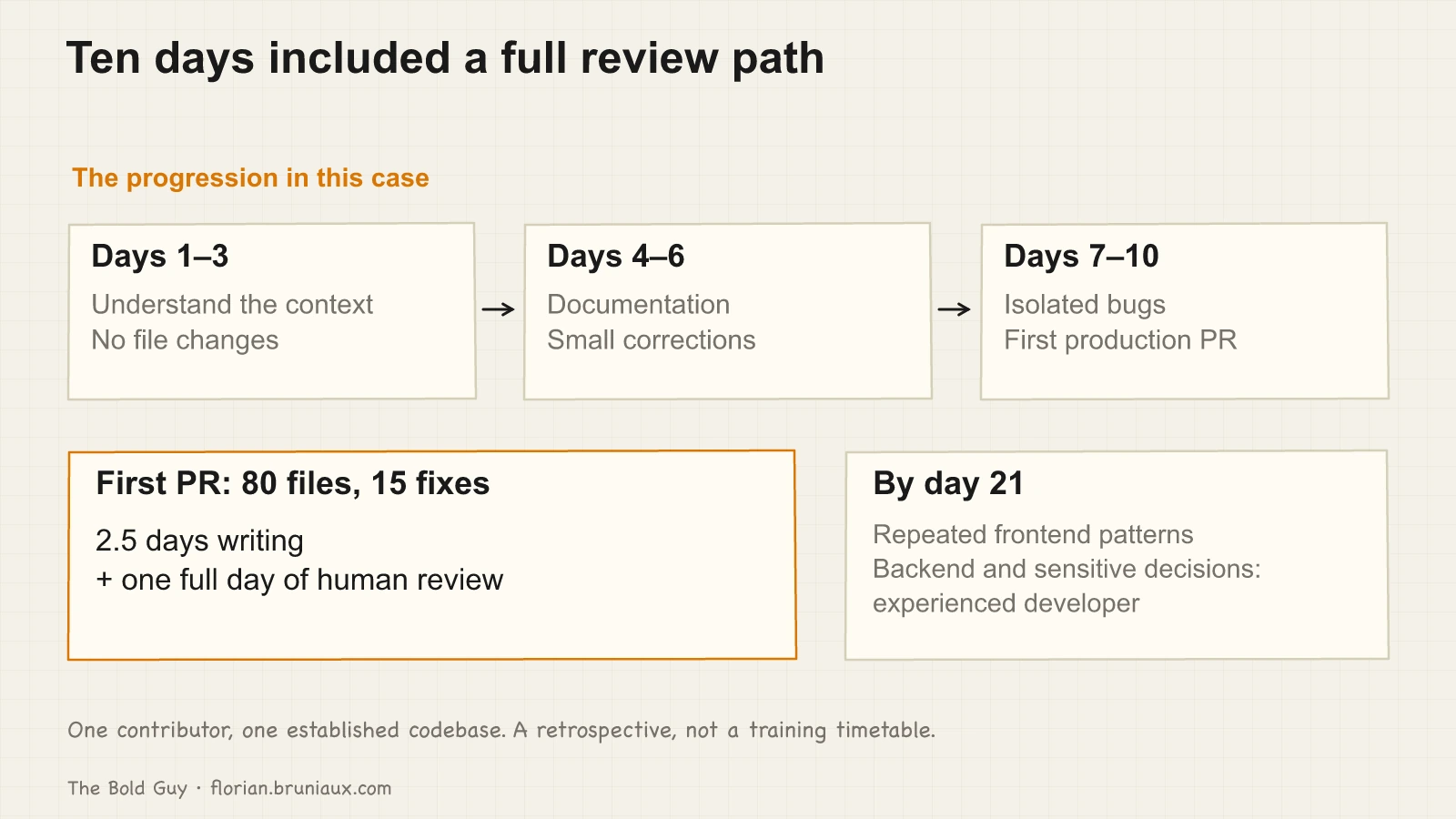
The timeline preserves the exact progression rather than smoothing it for the story.
Days 1-3: Zero code, full context
Augustin queried the codebase using Cursor’s AI features to understand what existed. He improved specs in Notion using AI assistance, not writing code but using AI to write clearer requirements. Zero files modified, and that was intentional.
The 3-tier architecture of the codebase matters here. Every service follows the same pattern: Routers validate and pass through, Services own business logic and permissions, Repositories handle CRUD. Consistent across all 45+ services. When the pattern is consistent, an AI can explain it reliably. When it isn’t, the AI gives you the average of contradictory patterns.
Days 4-6: Safe changes
The changes were small on purpose: typos corrected, Markdown files in the knowledge base updated with business terminology, documentation patches. Nothing that touched the actual application logic.
That last category wasn’t trivial. Augustin knew the business domain better than I did. He’d been working with the founders for months. When he updated the knowledge base, he was feeding the system the business rules the AI would use to help every developer on the team. The safe changes were also useful ones.
The goal wasn’t to build confidence through success. It was to build familiarity with the process: making a change, seeing it in Cursor, understanding what a commit is, what a PR is, what review feedback looks like.
Days 7-10: Isolated bug fixes with Cursor AI
I gave him specific tickets. “The button doesn’t appear at the right moment.” “This click redirects to the wrong URL.” Bugs I’d identified as isolated, well-contained, safe to hand off.
He worked with Cursor’s AI to understand the relevant components, make the change, test it locally. I pointed to the exact file when needed.
Day 10: First PR in production
80 files modified. 15 bug fixes in one PR.
Two and a half days of work on his side. One full day of review on mine.
“Functionally, everything was broken. But it worked.”
That quote is accurate. The PR had bugs in the way it handled edge cases. Some of it wasn’t just CSS and redirects. There was real React hook logic in there, the kind of thing where wrong assumptions about component lifecycle produce subtle and intermittent failures. The review caught those. I used Claude myself to navigate the 80-file diff, asking it to flag the patterns that looked off given what it knew about the codebase architecture. The risk of reviewing AI-generated code you don’t fully understand runs in both directions. Comprehension debt isn’t only a problem when you’re the one shipping.
The final merged version was clean. But what stuck with me was the fact that 80 files could be modified by someone who had never opened a terminal, with a day of review rather than a week, and the result was shippable.
I was more proud of that merge than any of the 49 releases we’d shipped in the previous 7 months. The code had flaws, yet the merge proved the model worked. Someone else had stepped inside the system I’d built and shipped something real.
Day 21: Multiple PRs per day
Three weeks after discovering Cursor, Augustin was shipping at the pace of senior developers I’d worked with in my best teams. His scope excluded backend work, data-model design, and the security layer. Within frontend work and pattern replication, the throughput was real and measurable.
The 3 factors that made it work
1. Adapted AI context
The profile system meant his AI understood the project at the right level of detail. Business rules, architecture conventions, the specific patterns used in the codebase, without the advanced tooling noise that was irrelevant to him.
The right amount of context produces useful output. Too much confuses it (the model starts hedging or averaging across irrelevant information), too little and it hallucinates the project’s conventions. 289 lines wasn’t minimal for simplicity’s sake; it was minimal because that’s what his workflow needed, with the full foundation of business and architecture knowledge shared across every profile.
The distinction matters: his AI wasn’t just aware of the code structure. It understood what the product was supposed to do. That’s what let it navigate a component change without treating the codebase like an unfamiliar library.
2. Replicable architecture
The 3-tier architecture serves a transmission purpose beyond code quality.
When I create a new service, the entire chain is replicable: tRPC router with Zod validation, service layer with business logic and permission checks, repository with typed Prisma queries. The AI knows the pattern because it’s consistent across 45+ services. It can apply it because there’s no ambiguity about where each piece of logic lives.
Augustin doesn’t write novel architecture. He replicates established patterns, and that distinction is the key. If the codebase was inconsistent (different patterns in different places, business logic scattered across layers), the AI’s output would reflect that inconsistency. Architecture discipline creates the conditions for non-technical contribution. It’s not something you add after the fact: if it’s not there when someone new joins, you’ll see it immediately in the quality of their AI-assisted output.
3. Measured progression
Days 1-3 without touching code wasn’t wasted time. It was investment in context before output.
The progression was deliberate: understanding before modifying, safe modifications before consequential ones, isolated bugs before multi-component features. Each step built the foundation for the next. Skipping steps would have produced faster early commits and slower overall progress.
The temptation when someone new joins is to give them something real to do immediately, to prove the model works. The more reliable path is to let the understanding accumulate before the output does. That’s counterintuitive when velocity is the goal, but Augustin’s day 21 pace validated the patience of day 3.
The human-AI pair after day 21
The division of work is clear:
Florian: Backend, services, data models. He lays the foundations and makes the architecture calls.
Augustin: Frontend, pattern replication. No technical innovation on his end, but he replicates established patterns with real consistency.
When I say “Augustin”, I mean him and his AI assistant. Together, they form a human-AI pair that ships. The productivity figures only make sense in that framing. Cursor gave Augustin the means to ship 80-file PRs in 10 days, while Augustin supplied the product understanding that grounded its output in business needs.
| Contributor | Commits | Share | Role |
|---|---|---|---|
| Florian | 902 | 82% | Backend, architecture, review |
| Nico | 60 | 5% | Product design |
| Augustin | 53 | 5% | Frontend, pattern replication |
Of Florian’s 902 commits, the majority were co-authored with Claude, making it the second most active contributor when measured by co-authorship. The human-AI pairs are visible in the workflow, not as a metaphor but as a daily operating mode. The full commit breakdown and what that 36% share represents is covered in Claude Is My Second Contributor.
Two more people are onboarding now using the same model. Ben (the founder) started with simpler tickets. Matisse, a product profile, began contributing to discovery work. The system Augustin proved out is spreading, one profile YAML at a time.
What this says about recruiting in 2026
The traditional hiring filter is implementation fluency: can you write the code from scratch? That filter made sense when the bottleneck was writing. In 2026, the relevant question is whether someone can understand a system well enough to extend it with AI assistance. Those are different filters, and they select for different people.
Augustin can’t write a tRPC router from first principles. He can extend one because the pattern is established, the AI understands it, and the review process catches the gaps. That’s a different capability than traditional development, and it’s genuinely useful for a certain class of work.
Developers remain necessary. The 3-tier architecture that made Augustin’s contribution possible required someone who understood why those layers exist. Catching the edge cases in his Day 10 PR review also required someone who could reason about the system end-to-end. MCP server configurations, security guardrails, and database optimization are outside Augustin’s domain for now.
In practice, structured vibe coding uses prompts within constraints and an architecture built to be replicable.
What changed is the entry point. You used to need fluency in the implementation layer to contribute to a codebase. Now you need enough structural understanding to extend existing patterns with AI in the loop, and a review process that catches what the AI misses. Those are genuinely different skills. They existed before, but they weren’t useful in this specific context until AI tools made the gap small enough to bridge.
The Cartesia team would have said no to this experiment. They were right by their model. I’d seen enough to think their model was worth testing, and the 10 days that followed gave me a concrete answer.
The conditions behind 10 days
A non-technical person shipped 80 files to production in 10 days and was matching senior developer throughput by day 21. The profile system supplied calibrated context through the 289-line version that included the complete business domain. The architecture gave that context consistent patterns to extend, and the progression let understanding accumulate before output. All three had to be in place. The hiring question for 2026 is whether someone understands your system well enough to extend it with AI in the loop, and whether the codebase supports that work. Augustin’s result depended on the infrastructure already being in place.
The profile system described here (modular YAML profiles producing different CLAUDE.md outputs per developer) is part of the AI configuration architecture built at Méthode Aristote. Documented in the Claude Code Ultimate Guide.
YSNK
(You should now know)
- The tool choice came down to environment friction before AI at all: Windows versus the Mac-only shell hooks and zshrc config, which made Cursor’s visual IDE the practical pick over Claude Code
- Days 1 to 3 touched zero files on purpose. Understanding the codebase came before any output, and the day-21 pace validated that patience
- Reviewing an 80-file AI-generated diff got its own AI assist: the reviewer used Claude to flag patterns that looked off against what it already knew of the architecture. Comprehension debt runs in both directions
- Two more non-technical profiles have since onboarded on the same model, a founder and a product person, one YAML profile at a time
- The frame that generalizes: structured vibe coding is prompt-within-constraints inside a replicable architecture, not prompt-and-pray. The architecture has to exist first
Go Further in the Claude Code Guide
Practical resources selected to help you take the next step.
Open-source galaxy
Projects used in this path
Related appearances
Live appearances and podcast episodes about this article.
Related articles
Choose your AI-assisted engineering starting path
Choose between Claude Code and Cowork, then follow the Start, Build, or Scale path that matches your role and current operating problem.
Claude is my second contributor: what real Git stats show
6 contributors in our git history. One is an AI. What the commit patterns actually look like after months of Claude Code, beyond the marketing claims.
From afterthought to infrastructure: how AI config evolves in a real project
Nine months of AI configuration in one production project: evolving responsibilities, profile-based generation and a measured reduction in always-on lines.