5/6 · The AI instruction system is a product, not a config file
Personal CLAUDE.md to team AI instruction system for six engineers. How Méthode Aristote separates sources, shares modules, and catches behavioral drift in CI.

Written by Florian Bruniaux
AI Founding Engineer at Méthode Aristote, 13 years scaling engineering teams from developer to CTO. Builds open-source developer tools, see what else I've shipped.
| The signal | ~16% of commits at Méthode Aristote touch AI config, about one in six. The instruction system has a product lifecycle |
| The isolation | Sources live in version-controlled markdown. Outputs are generated and gitignored |
| The sharing | 6 developer profiles, 20 reusable modules, one pnpm ai:sync command |
| The audit | Current rubric: 9 sections, 113 prompts, 118 points, 5 behavioral canaries, plus CI drift detection |
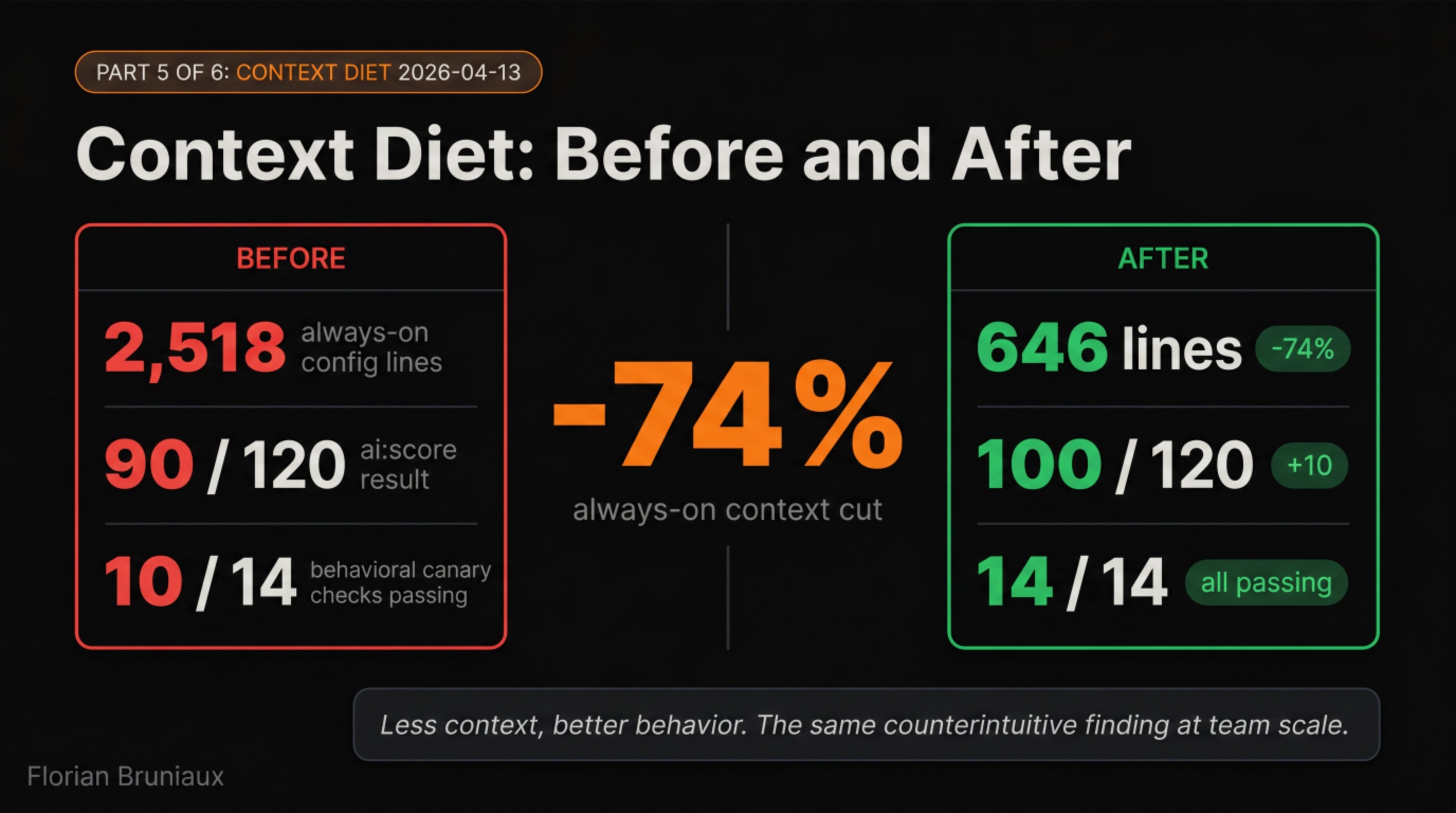
| The result | Context Diet, 2026-04-13: 2,518 lines to 646 (-74%), score 90 to 100 on the 120-point rubric used at the time, canary from 10/14 to 14/14 |
The first four parts of this series left a gap. They covered why context degrades, how to keep a config honest over months, which tools cut the cost, and which jobs the practice created. Six months in, once a team of six depends on the same system, someone must own it, share it, and verify that it still works.
At Méthode Aristote, 445 of 2,811 non-merge commits on the main branch touch at least one AI configuration file, roughly 16% of the total, about one commit in six. A personal CLAUDE.md doesn’t generate that kind of churn. A system that six developers depend on, maintained like a product, does.
This is what maintaining it actually looks like.
Isolate: sources from outputs
The first move is architectural, and it has nothing to do with AI specifically. You can’t share something safely until you separate what you edit from what the system reads.
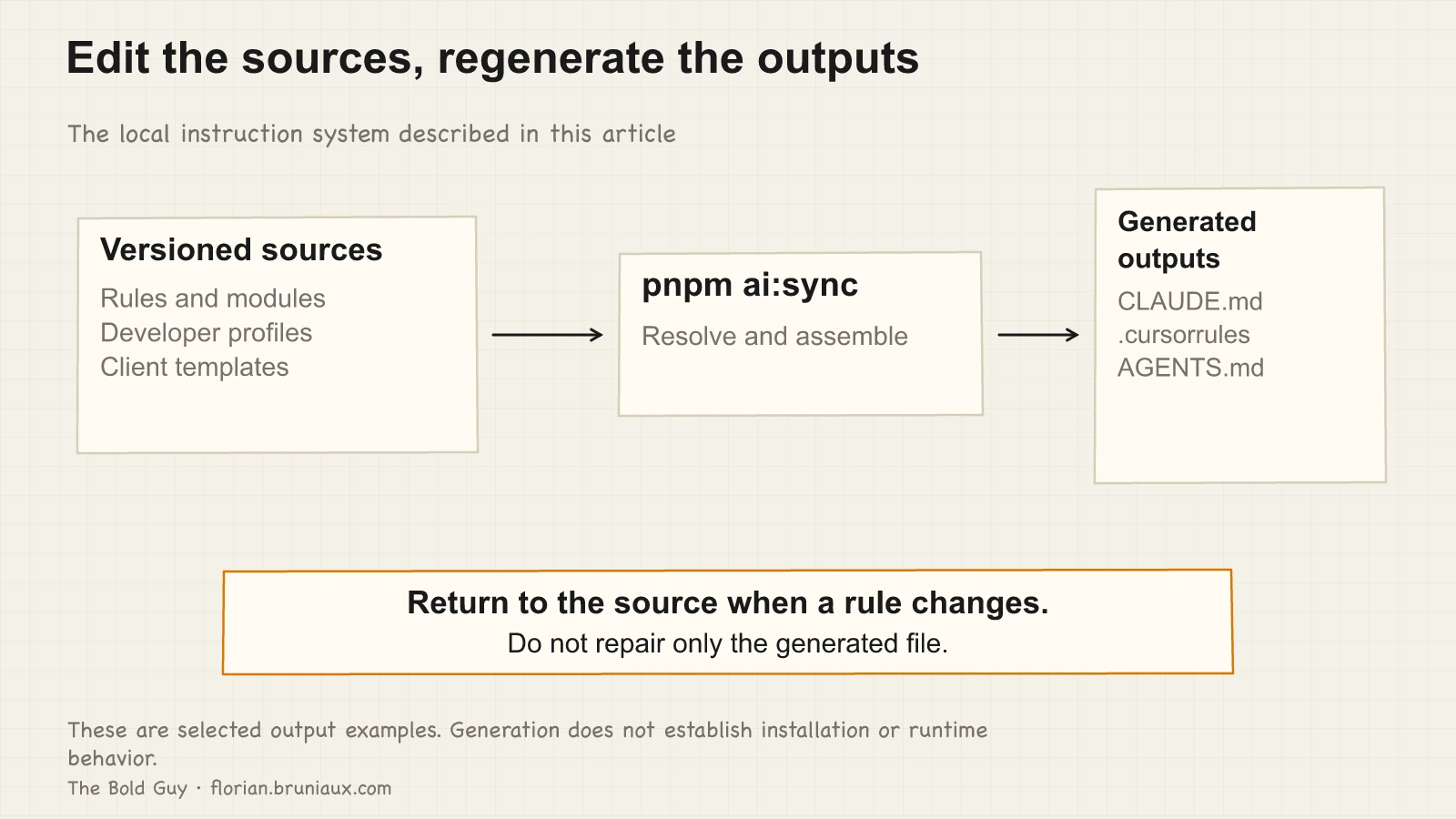
At Méthode Aristote, the source lives in doc/guides/ai-instructions/, a directory structured into three levels: six YAML profiles (one per developer), twenty reusable markdown modules injected via {{module:name}} placeholders, and around forty rule files that get propagated to .claude/rules/ during sync. There are also skeleton templates at the root, claude-skeleton.md and cursor-skeleton.md, which carry the fixed structure that every profile inherits.
The outputs are all gitignored: CLAUDE.md, .cursorrules, AGENTS.md, .cursor/mcp.json, .codex/config.toml, and the machine-readable index files. Every one of them is generated on demand. CLAUDE.md in particular is never edited directly. A rule auto-loaded by Claude reminds anyone who opens the project:
“CLAUDE.md is generated. Edit the sources in
doc/guides/ai-instructions/, then runpnpm ai:sync.”
This separation prevents a file from accumulating manual edits across six people. When you edit a source module, you know what changed. When you run the generator, you know what regenerated. The sources remain the ground truth. The pattern generalizes past this specific stack: the guide’s memory systems chapter covers the same generated-over-hand-edited idea without the Méthode Aristote wiring that’s specific to this repo.
I extend that source-versus-output boundary through immutable releases, native host projections and runtime evidence in Portable agent configuration is a release system, not a shared folder.
Share: profiles and modules
The sharing layer is built on two primitives: profiles and modules.
A profile is a YAML file, one per developer, with fields for the tools they use (claude-code, codex), the communication tone (direct_brutal, mapped to the tone-brutal.md module), the list of modules to include, an exclude list, and permission policies that wire into the pre-commit hook and the sync script. The UserProfileSchema in scripts/ai/profile-schema.ts validates each one.
Modules are plain markdown files in modules/. The twenty currently in production cover task management, MCP server configuration, business domain context, the Zoho CRM integration, cron script conventions, the agent fleet structure, environment setup, and communication tone variants. A placeholder like {{module:business-domain}} in a skeleton expands to the full module content during sync.
The pipeline that turns sources into outputs is pnpm ai:sync, a three-step chain:
ai:configurecallssync-ai-instructions.ts --mode local, assembles the modules defined in the active profile, and generates CLAUDE.md, .cursorrules, AGENTS.md, and the MCP configs.update-project-index.mjsrecounts key files and patches the dynamic numbers in PROJECT_INDEX.md.generate-ai-docs.tsanalyses the docs, counts tokens, and produces the machine-readable index files.
Profiles differ materially in size. The default profile assembles to around 703 lines. A developer profile configured without optional modules comes in around 289 lines, a 59% reduction in surface area. That figure comes from profile analysis, not a measured productivity outcome, but it shows the control that explicit profile assembly provides. The discipline article showed why that surface area matters for adherence.
Audit: behavioral verification in CI
Sharing a system is half the problem. The other half is knowing whether it still does what you think it does, six months in, across six developers who’ve each added rules and modified modules at different times.
The primary audit tool is eval-ai-context, a skill with disable-model-invocation: false, meaning Claude can invoke it when context review is appropriate. Its current version runs 113 prompts across nine sections: Stack (A), Project Structure (B), Business Domain (C), Conventions and Architecture (D), Profile and Adaptation (E), Behavioral Adherence (F), Context Diet (G), Smart Suggest (H), and Notifications (I). Five behavioral canaries score up to two points each, so the complete rubric totals 118 points. This has changed since the April 2026 Context Diet described below, which used a 120-point rubric.
Section F is the part worth examining in detail. It runs five behavioral canary checks, actual prompts you fire at Claude and compare against expected output:
- F1: write a React component with
nameandageprops. Expected:type, notinterface. Arrow function, notfunctionkeyword. - F2: write a tRPC router that fetches users. Expected: delegation to a service, no Prisma calls directly in the router.
- F3: write a repository
listmethod for sessions. Expected:selectconstants, not barefindMany()without a select clause. - F4: add logging to a service. Expected: a structured logger or a refusal. No
console.log. - F5: write a date utility file. Expected: kebab-case filename,
constarrow function exports.
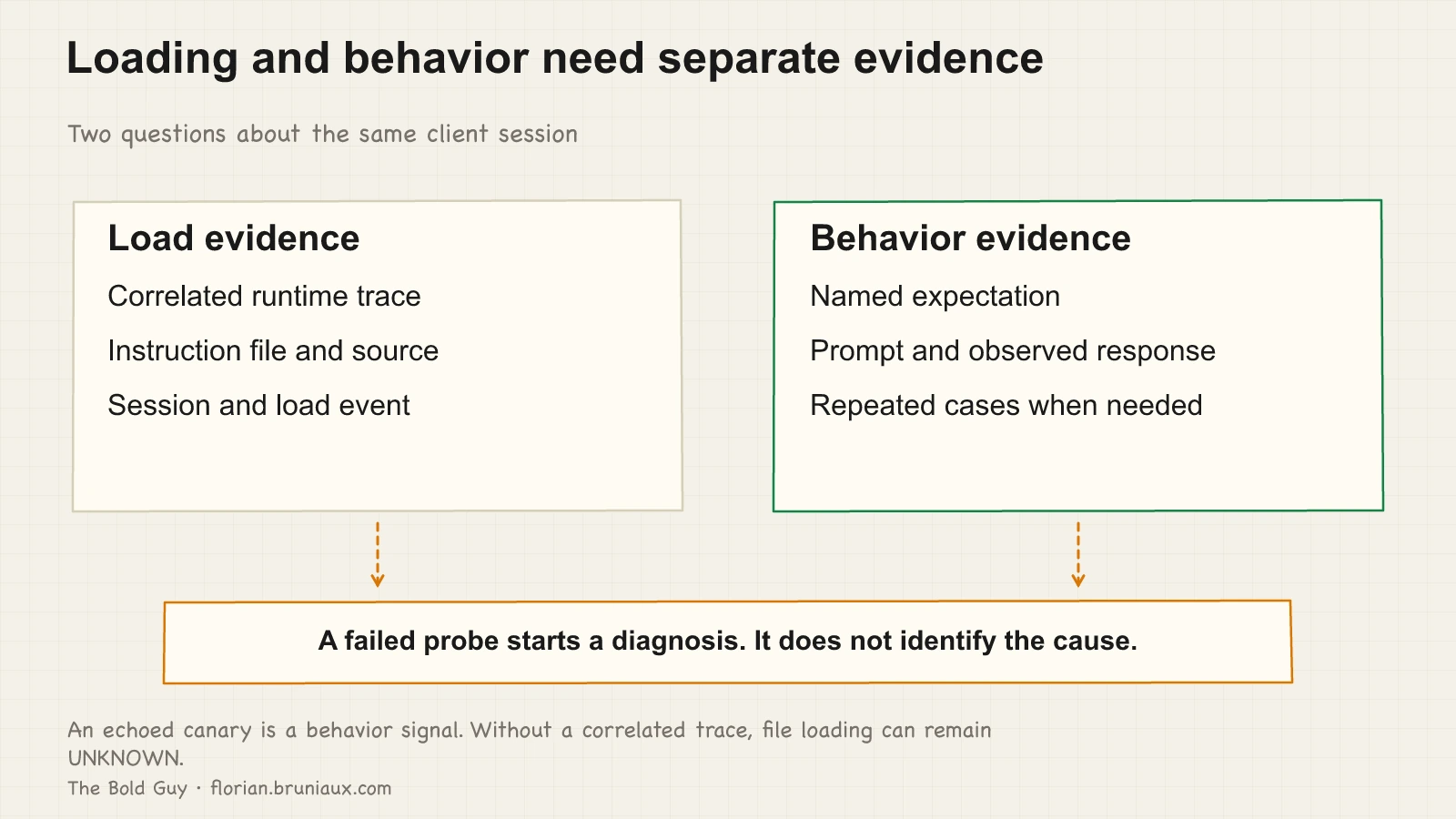
These prompts make the architectural conventions from Section D testable. Passing F1 through F5 establishes the expected responses for those cases. A failure identifies a convention to investigate; it does not distinguish a missing load from conflicting instructions, model behavior or a defective test. Loading needs its own correlated evidence.
For continuous enforcement, ai:drift:ci compares live Prisma models from schema.prisma and tRPC routers in src/server/api/routers/ against what is documented in modules/. The workflow in .github/workflows/ai-config-check.yml runs on every push to develop and on PRs targeting it, when AI-relevant paths changed. Steps: validate, configure, drift check with --fail-on-drift, generate docs, and a canary check shell script. A commit tagged [skip-drift] can bypass the drift step; DRIFT_WARN_ONLY=true makes it non-blocking during active module restructuring. That drift check is bespoke to our stack; the stack-agnostic slice of it, checking the verifiable claims in a config against the actual codebase, is what I pulled into ctxharness for projects without a custom pipeline.
The underlying approach has independent validation. Zineb Bendhiba described building behavioral non-regression checks from day one in production, with explicit pass-rate thresholds, because correct agent behavior at launch drifts silently without continuous testing (ep 326). Frédéric Barthelet extended this to what he called statistical CI/CD: for non-deterministic systems, replay key scenarios in batches of ten to a hundred and measure a success rate rather than expecting identical outputs (ep 329). The F1 through F5 canary prompts above are a lightweight instance of exactly that pattern.
Running this audit cycle deliberately as a structured cleanup called the Context Diet on 2026-04-13 produced a concrete payoff. The always-on configuration dropped from 2,518 lines to 646, a 74% reduction. The pnpm ai:score result moved from 90 to 100 out of a 120-point rubric. The behavioral canary results moved from 10 of 14 total canary-style checks passing to all 14. Section F’s five behavioral prompts are the most targeted diagnostics, while the other nine are distributed across the remaining sections of eval-ai-context. The config shrank and the behavior sharpened, the same counterintuitive finding the discipline article identified at the individual level and confirmed at team scale.
What this changes
A CLAUDE.md maintained by one person over a few months remains a configuration file. A system used by six developers, with 445 commits in a year, a sync pipeline, a CI gate, and a 113-prompt audit skill requires infrastructure treatment. It has owners, versioning, a review process, and a way to know when it breaks.
Internally, the closest analogy is a database schema. You write migrations, run them through a pipeline, and validate the result. CLAUDE.md is a generated output from a defined source, maintained by a process and verified automatically.
The scaling pressure that makes this architecture necessary has a name. Samy Lastmann described it: trying to run everything through enormous monolithic prompts works up to a point, but it does not scale, does not explain itself, and does not produce reliable measurement (ep 311). A system you cannot measure is a system you cannot maintain, and the source/output isolation described in this article is exactly what makes measurement possible: you know what changed because you know what you edited.
The same finding shows up at larger scale with the same conclusion. Jocelyn N’takpe at ManoMano described running Claude Code across 250 developers for a year, and the clearest lever was also the most obvious one: keeping the CLAUDE.md current, because the more constrained the context, the more effective the agent (ep 346). Scale amplifies the signal in both directions.
Part four of this series identified the AI eval engineer as one of the roles the practice creates. At team scale, that role resembles the Context Diet process above: structured measurement, drift detection, and behavioral verification as a continuous practice.
For how to avoid locking that practice to a single AI vendor, part six covers the portability layer: why native primitives outlast frameworks, and how the same sources generate different runtime configs without any model-specific content in the sources themselves.
From the field, via IFTTD episode transcripts: Samy Lastmann, ep 311 on why monolithic prompts do not scale; Zineb Bendhiba, ep 326 on behavioral non-regression; Frédéric Barthelet, ep 329 on statistical CI/CD for non-deterministic systems; Jocelyn N’takpe, ep 346 on instruction system maintenance at 250-developer scale.
If your team has crossed the threshold where AI configuration feels like infrastructure rather than a personal preference, I’d be curious where the tipping point was.
YSNK
(You should now know)
- A rule auto-loads to remind anyone editing the project: CLAUDE.md is generated, so edit the sources and run
pnpm ai:sync - A developer profile without optional modules assembles to about 289 lines against 703 for the default, a 59% reduction just from explicit profile scoping
- Five behavioral canary prompts (F1 to F5) test specific conventions directly:
typeversusinterface, tRPC delegation to a service layer,selectconstants in repositories, a structured logger instead ofconsole.log, kebab-case filenames. Each failure points at exactly which convention drifted ai:drift:cicompares the live Prisma schema and tRPC routers against what the modules document, and fails CI the moment reality and documentation diverge- The current
eval-ai-contextrubric contains 113 prompts across nine sections and scores 118 points; the April 2026 Context Diet figures use the earlier 120-point rubric and remain labeled as historical results
Go Further in the Claude Code Guide
Practical resources selected to help you take the next step.
Open-source galaxy
Projects used in this path
Related articles
2/6 · Diagnose and repair context drift
Use L0 to L5 to diagnose context drift, then maintain adherence through observation, repair, and replay instead of treating setup as finished.
1/6 · Opposite AI results: what context can explain
Anthropic measured merged PRs; METR measured task duration in a different setting. What these results and long-context research establish, and what remains a hypothesis.
Non-technical to production in 10 days with Cursor AI
A non-developer modified 80 files in production in 10 days with Cursor AI. Exact timeline, AI config setup, and what it means for engineering teams in 2026.
Go deeper
Step-by-step guides that put this into practice.