My Chief AI Officer playbook
Florian Bruniaux’s Chief AI Officer playbook. 6 steps for choosing an AI use case, checking the result and deciding what comes next, with 7 team worksheets.
 Florian Bruniaux 38 min read
What you'll set up
- ✓ Frame useful AI work and its expected result
- ✓ Prepare decisions and usable handoffs
- ✓ Separate contribution, verification and acceptance
- ✓ Support learning and examine results before expanding
Guidelines for leadership, product and the teams doing the work.
This playbook draws on work at Méthode Aristote and client engagements. The companion article starts with the product decisions that can hold up faster delivery.
TL;DR
Start with a trial small enough for someone to examine the result and decide what happens next.
- Frame the need. Name who has the problem and the result that would help.
- Prepare the handoff. Record who decides, why and when to reopen the decision. Check who has the time and access to take it on.
- Assign responsibilities. Name who builds, verifies, accepts and maintains the harness.
- Make room to learn. Set aside time for real work, authorised tools and someone who can help.
- Measure before expanding. Record the baseline, then compare use, quality, waiting and effort.
The 6 steps · The 7 team worksheets
Choose work worth doing
A useful problem and an expected result, before choosing the means.
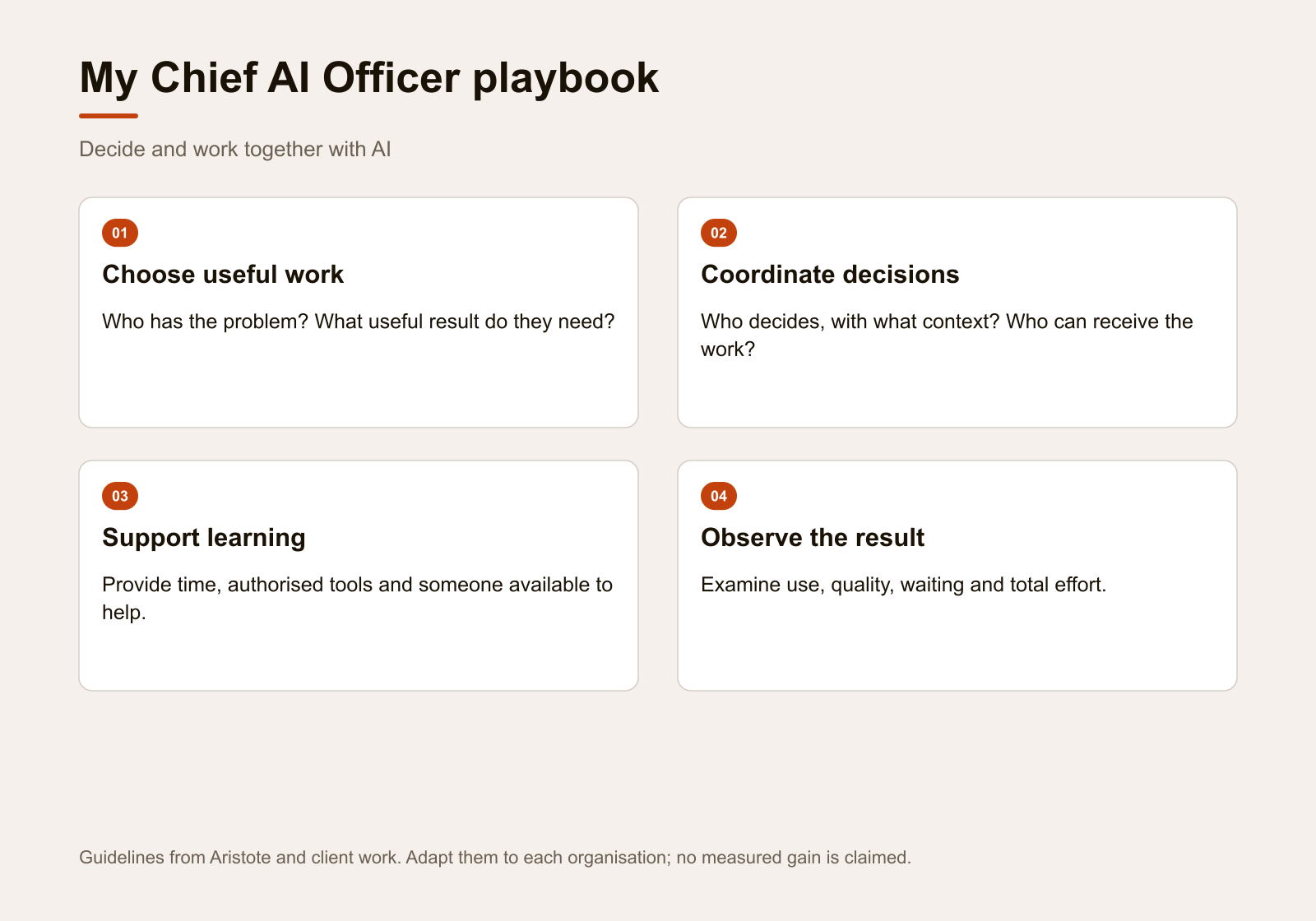
Responsibilities around the team’s work.
My Chief AI Officer role connects leadership choices with the team’s work. I ask who has the problem, what would help them and who can examine the result. AI takes its place in that work once the need and responsibilities are clear.
This playbook draws on Aristote, client engagements and my experience in startups, scale-ups, small and medium-sized businesses, and large organisations. Context changes the means, access and decision process. The guide offers working guidelines to adapt to each organisation.
Aristote: a catalogue that became hard to understand
Users told us the growing catalogue of features reminded them of Netflix. We could sometimes add features faster than we could explain them or check that they met a need. In the passage at 14:21, I discuss why we needed to choose more carefully what to ship.
Adapt the framework to your organisation
Examine how critical the work is, the skills available, the possibility of reversing a change and the capacity to verify it. A small team may lack a second perspective; a large organisation may lack a clear decision across functions.
The first trial needs a named beneficiary, expected result, scope and person who will examine it. The framing worksheet helps establish that agreement.
Check the conditions before starting a trial
Before starting, I list the path to real use: security or compliance approvals, data access, purchasing and the test environment. Ask early and keep the request small, within the authorised framework, to avoid discovering a blocker weeks after starting.
I choose a trial whose blockers are within the team’s reach. A team waiting for another team’s decision or service cannot establish how well the practice being tried works. A team under heavy delivery pressure often has little time to learn.
Faster production also loads the receiving side: review, continuous integration, test environments and product decisions. I examine that load before accelerating and involve product and design from the start of the trial.
Unblock decisions and handoffs
Who needs to decide, with what context, and who receives the work?
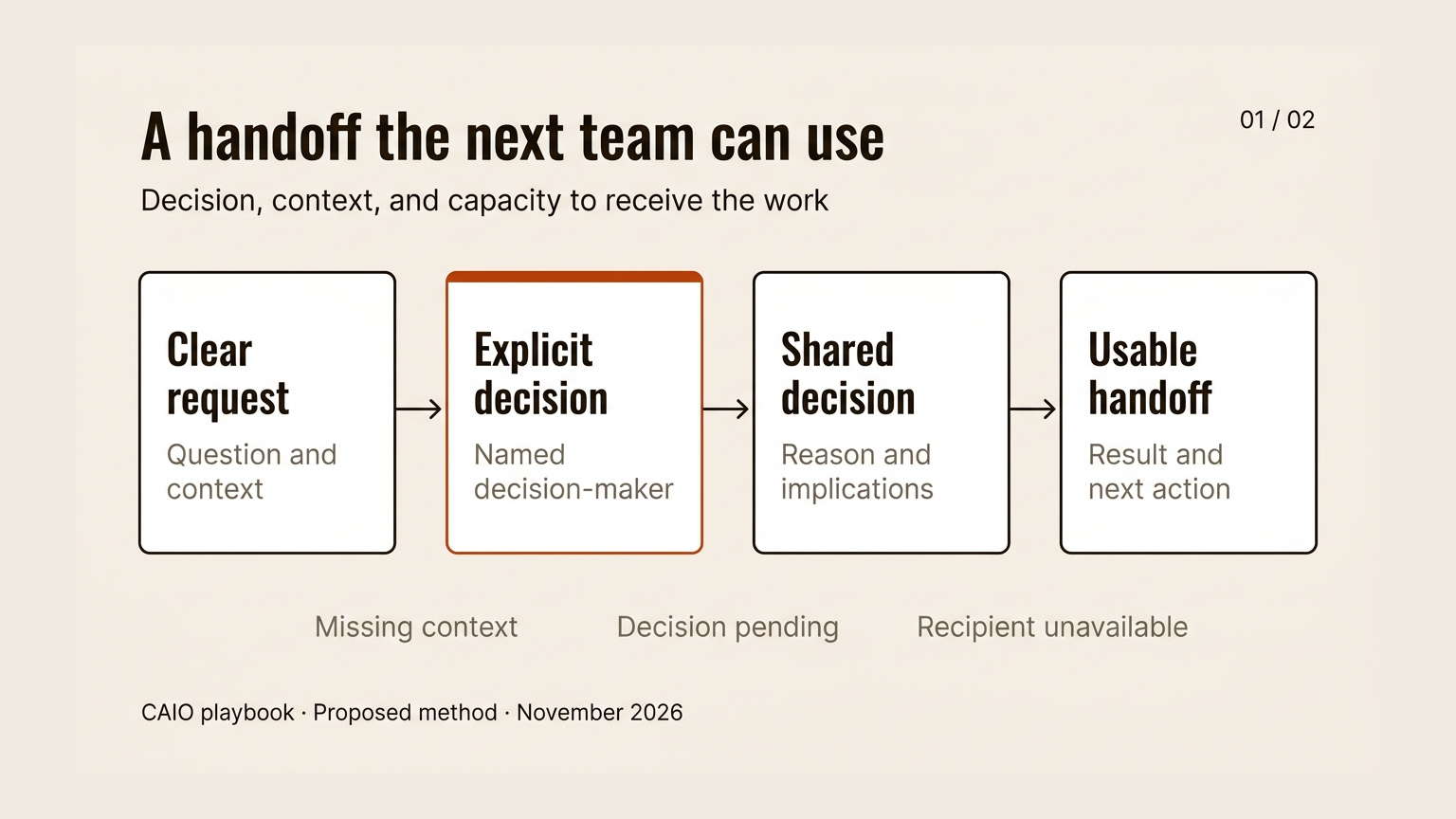
Find the cause of waiting before adding a tool.
I start by following real work with the people involved: where does it wait, what information is missing, why does it go back? This helps distinguish a missing decision, a context problem and a team that cannot yet receive the next step.
For each handoff, I want a precise question, a named owner and an understandable next action. Local decisions should move forward within an agreed framework. Decisions affecting several teams need the appropriate people. The recipient also needs capacity to receive this work.
AI assistance can prepare a summary or extract open questions. A person checks the context and confirms the decision. The information also needs to be received and understood by the people whose work changes.
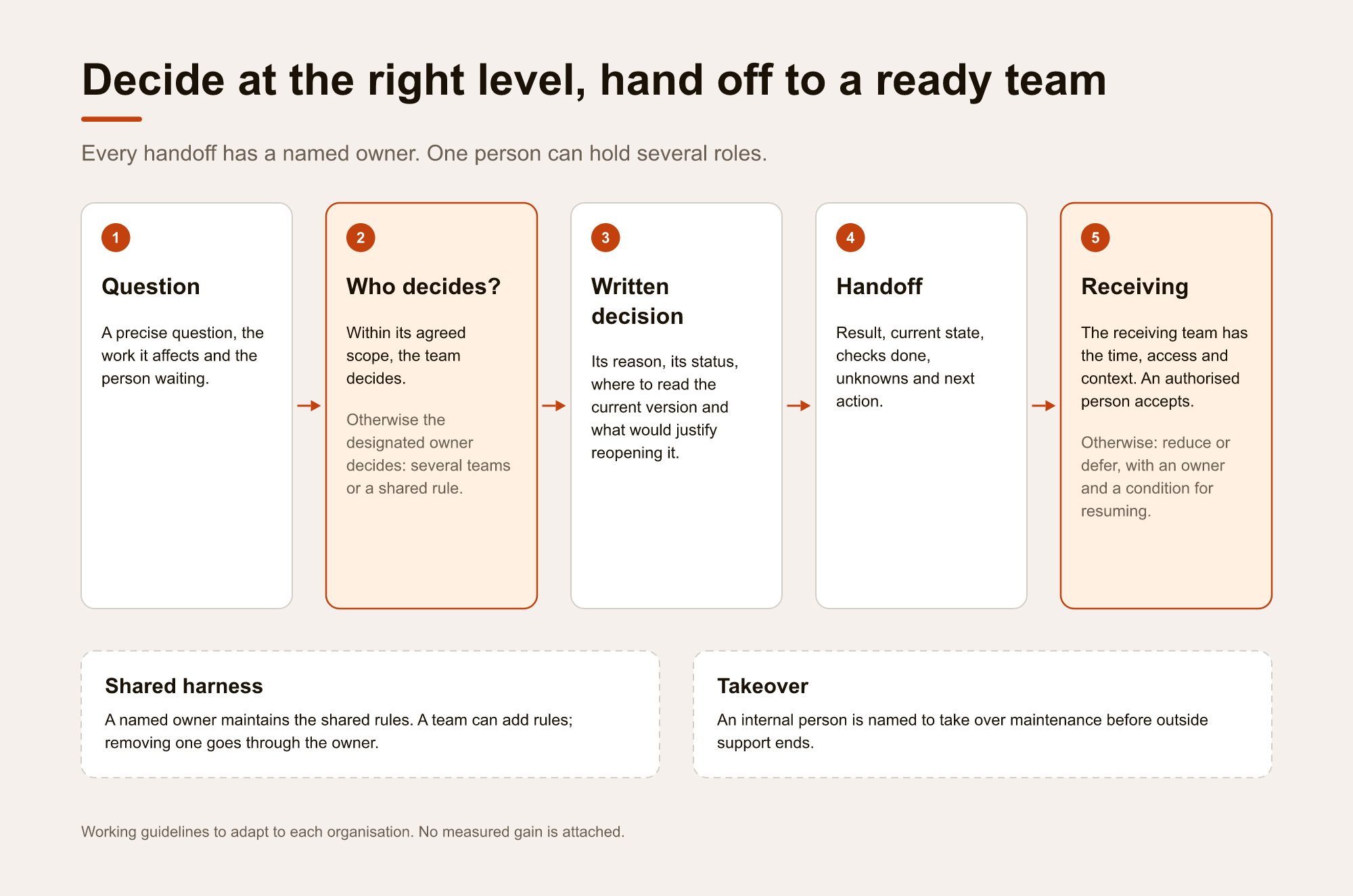
Who decides, what is written, who receives. Editable local diagram.
Some debates return every week because nobody can point to the decision. I keep a written decision small enough to settle one or two questions, with its reason, status, where to read the current version and the situation that would justify reopening it. Without that condition, every new participant can restart the discussion.
A rule can look clear to those who wrote it and vague to those applying it. Before adding a meeting, I ask the team concerned to apply it to a real case, then fix the text, owner or handoff. A written decision, named owner or usable handoff often helps more than a new ritual.
Changes to try on a chosen workflow
From a blocker to a change to test
| Blocker to look for | Change to try |
|---|---|
| Nobody knows who decides | Name the decision owner and the information needed |
| The same debate returns at every meeting | Write a short decision, its status and the condition that would justify reopening it |
| Every question goes to the same manager | Define the decisions the team can make within its scope |
| Scattered or contradictory instructions | Keep a reference for the decision and its reason, then explain its consequences |
| The recipient has to reconstruct the context | Hand over the result, its state, the checks and the next action expected |
| Too much work waits for an examination or answer | Defer or reduce work nobody can yet decide on or receive |
| The rule looks clear to its authors but vague to those applying it | Have the team apply the rule to a real case, then correct the text |
| Review, testing or product can no longer keep up | Examine the downstream load before accelerating and involve product and design from the start |
Choose the channel according to the need: a documented request can be handled asynchronously. A disagreement or ambiguity may need a discussion followed by a recorded decision. These practices are proposals clarified after the recording, without an attributed measured gain.
Keep the lasting decision with its reason, link the work state to its current source, then prepare a short handoff: what is expected, what was checked, the unknowns and the next person responsible. The Claude Code Guide handoff contract provides a technical form; it does not replace discussion with the recipient.
A decision that lives only in a private message or a meeting’s memory will be discussed again. A reference page mixing obsolete and valid content misleads people and the tools reading it: show its status and verification date, and remove superseded material. What people consult and what agents load from the repository may live in two places, provided one source is authoritative.
Who contributes, verifies and accepts
Delegating work requires named responsibilities and limits on action.
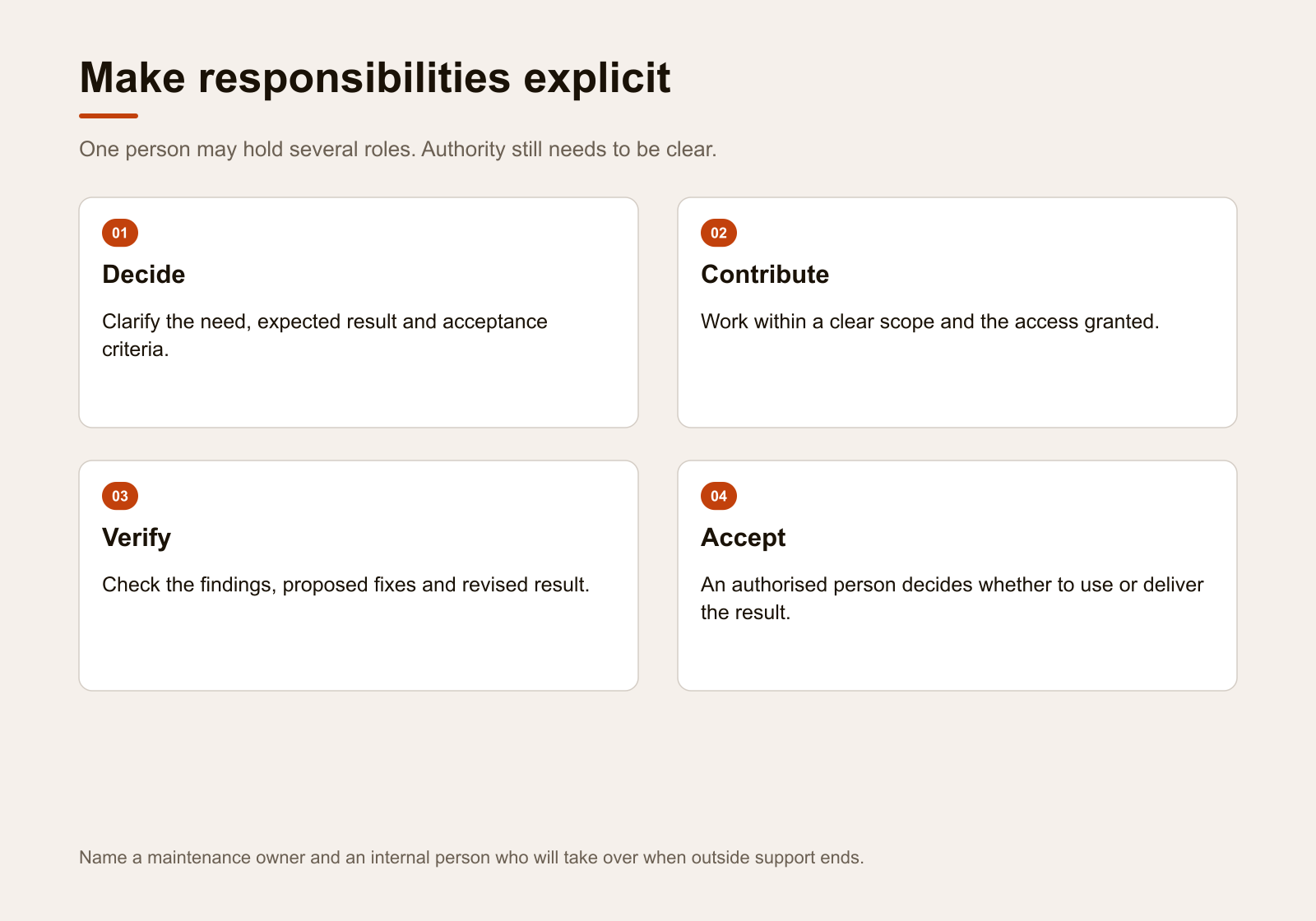
One person may hold several roles; responsibility stays explicit.
In the discussion of acceptance at 57:25, I explain that people who use Claude remain responsible for what they accept. They need to understand the result and be able to explain their decision. Contributing does not automatically grant authority to accept or publish the result.
The framework should allow progress: permitted actions, cases needing another opinion and someone available when work blocks. Several reviewers may flag the same error. Their agreement remains a finding to verify, including the proposed fix.
Outside support ends. From the start, I ask for the name of an internal person who will take over maintenance, and a handoff they have reviewed before I leave. A handoff counts when its recipient can name the next action and the person to contact.
Shared team harness and personal setup
What is shared and what belongs to the workstation
| Shared team harness | Personal setup |
|---|---|
| Project context, procedures, checks and responsibilities | Tools and settings specific to a person |
| Maintained sources and shared decisions | Preferences adapted to the work and environment |
| Behaviour to verify in each relevant environment | A personal configuration does not establish team use |
Profiles and instructions do not, by themselves, define access rights. Actions and authorised people need to be specified for the chosen use.
The shared instruction system holds sources and their owners. Configuration distribution then distinguishes the installed version, its loading and its effect. This establishes neither the same configuration on every workstation nor a collective benefit.
What teams share and what remains configurable
Rules sit at 3 levels: organisation, team and person. A team can add a stricter rule; removing or contradicting a shared rule goes through its owner. A change that can apply more broadly moves to the shared level, so a correction found by one team can benefit others.
An adapted copy of a shared component no longer receives its fixes. I prefer a versioned source referenced by each repository, with an owner, a few evaluated cases and a review of updates before distribution. An automatic update without review changes every team’s behaviour at once.
What arrives with the repository reaches more people than an installation step each person must perform. A local hook remains easy to bypass: it complements a shared check, rather than replacing it. Team context kept in a personal account leaves with that person.
These responsibilities should stay visible in the tools as well. An agent acting under a shared identity hides who decided; retain the author, the person verifying and the person accepting.
Learn through real work with help available
Provide time, tools and support within the job.
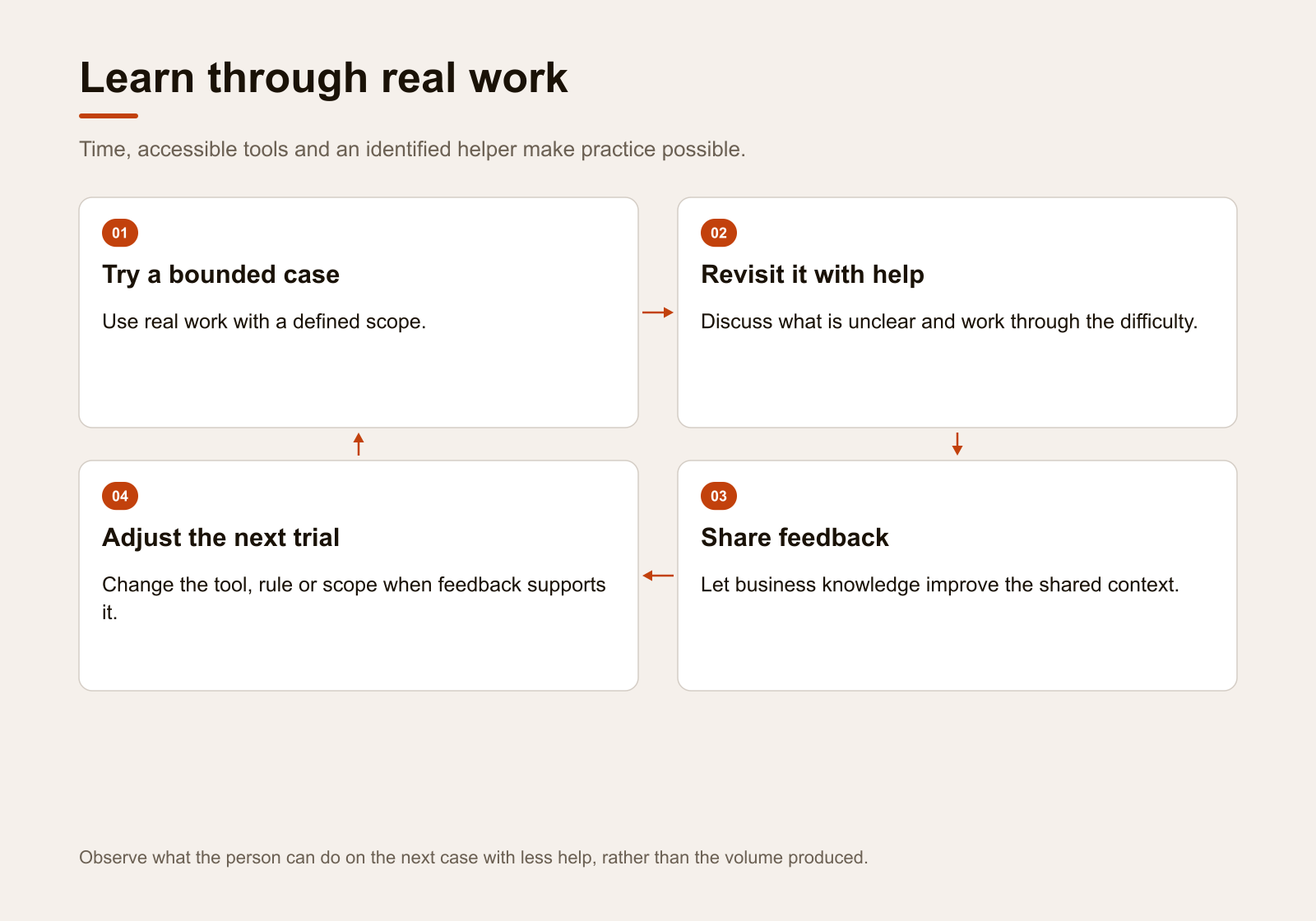
The trial helps both the person and the system improve.
I try many tools because I enjoy it. I cannot treat my personal time and enthusiasm as the effort expected of the whole team. The person responsible needs to make practice possible and provide help when it blocks.
A person learning a tool also brings business experience. What they find unclear, what they already know and the rules they make visible should improve the shared context. Feedback may lead to changing the tool, rule or trial scope.
Access comes before practice: tools authorised by the organisation, a known budget or quota and permission to use them on real work. When only some people have access, say who, why and when the others will follow. Otherwise the gap creates tension before anyone has learned anything.
A course or catalogue of agents does not change practices on its own. I look at what people reuse and improve in their work, rather than the number of items published.
Augustin: a supported business contribution
At Aristote, Augustin knew the product and its business rules. Support meant an adapted environment, a defined contribution scope and working through difficulties together. His business knowledge also enriched the shared context.
The early contributions needed review and corrections. Some topics remained with experienced people. The detailed account describes one case; its duration does not become a promise for another team. This case supplements the podcast sources.
Share what works and retain skills
Sharing needs an owner and protected time; otherwise it is the first slot cancelled. The person who found an improvement presents it, someone collects topics from teams, and reuse by another team counts as much as something new. A shared contribution can become part of the team review.
To retain the skills needed for verification, I keep some work done without assistance and ask people to explain in review what they accept. The observation concerns what the person can do on the next case with less help, rather than the volume produced.
The 6 steps of the playbook
Each step leaves a decision or evidence tied to the work examined.
- Frame the need. Name who has the problem and what result would help.
- Write the plan and challenge it. Revisit the need if the plan exposes a weak assumption.
- Build a bounded change. Keep it small enough for the person checking it to examine.
- Verify and review. Match the checks to the risk and test the revised version after each fix.
- Accept and observe. Have the authorised person decide, then look at how the result is used.
- Keep the lessons. Update the harness when feedback warrants it and check the effect the next time it runs.
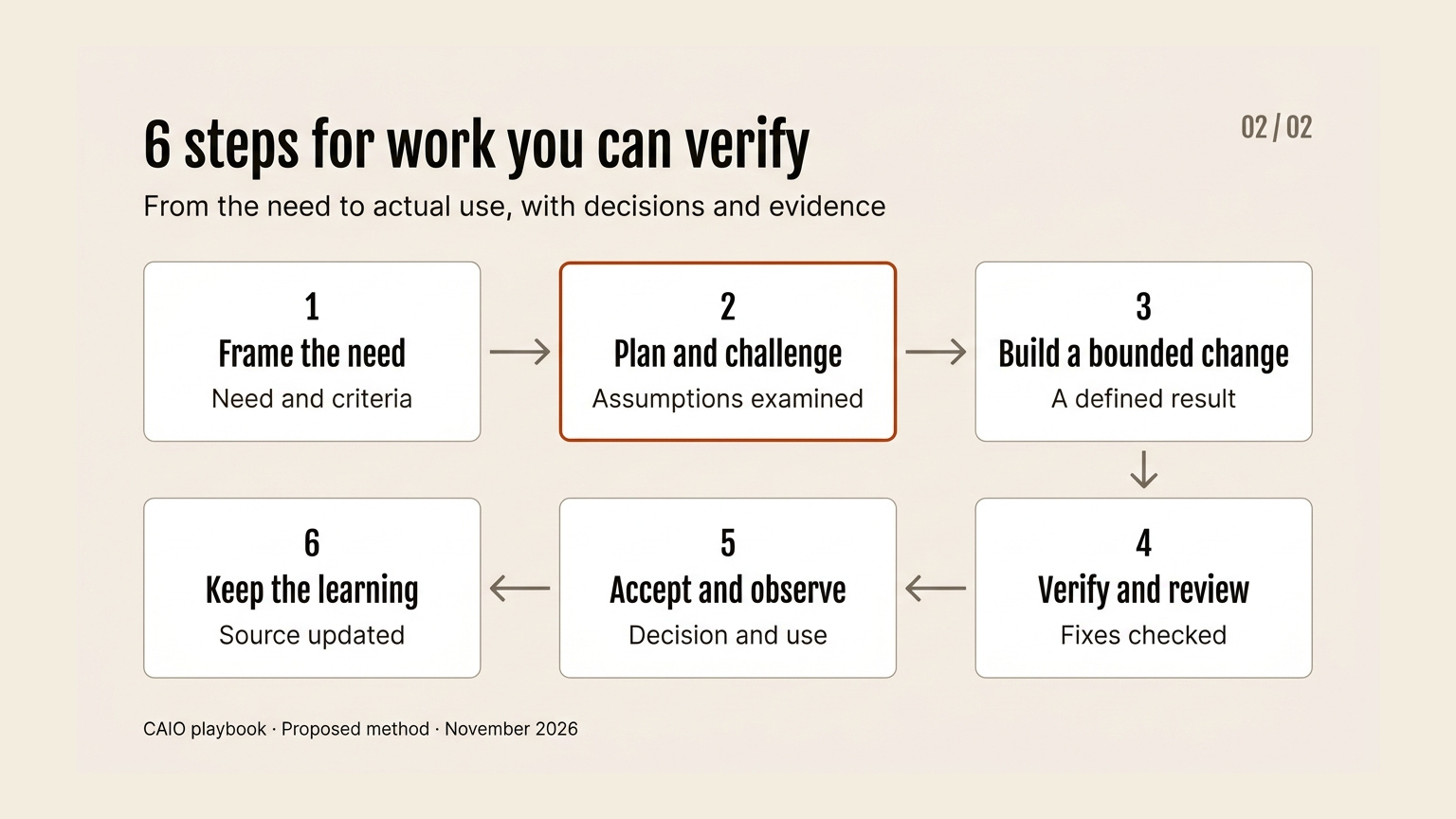
The execution loop discussed with Adam.
An identified person needs to be able to examine the work. Revisit the need and plan when an assumption changes. After a correction, recheck the revised version before deciding what happens next. The level of control depends on risk and the possibility of reversing the change.
The harness evolves with the work. Confirmed feedback may change a procedure, check or explanation. Name who maintains that change, then observe what happens on its next use. Adding a rule does not yet establish its usefulness.
Aristote: a review rule changed after a blocker
A review by 3 readers had been made mandatory. A teammate was blocked because an external reader was unavailable. The contract reviewed on 22 October required native review, added available and eligible external readers, and retained the trio on explicit request.
The preparation material documents the change. Its rollout across workstations and its effect on review time remain open questions.
Verify the system’s rules as well
The Aristote dossier dated 22 October distinguishes present, generated, loaded, executed and verified effect. A control also needs testing: did it run on the intended action, and did it change the expected result?
A critique may find no defect. A review should not manufacture an objection to fulfil its role. Technical mechanisms are developed in From code to merge.
An error in the code and a reviewer’s false alert do not necessarily call for the same correction. Improve the author and reviewer separately to avoid adding unnecessary code to satisfy a bad alert. For each change: an owner, the defect to detect, a valid case that should pass, then a decision to keep, revise or remove it.
Review an update to a shared procedure or component before distribution, then observe its next use, as with a code change.
Observe the result before expanding
Examine use, quality, waiting and total effort.
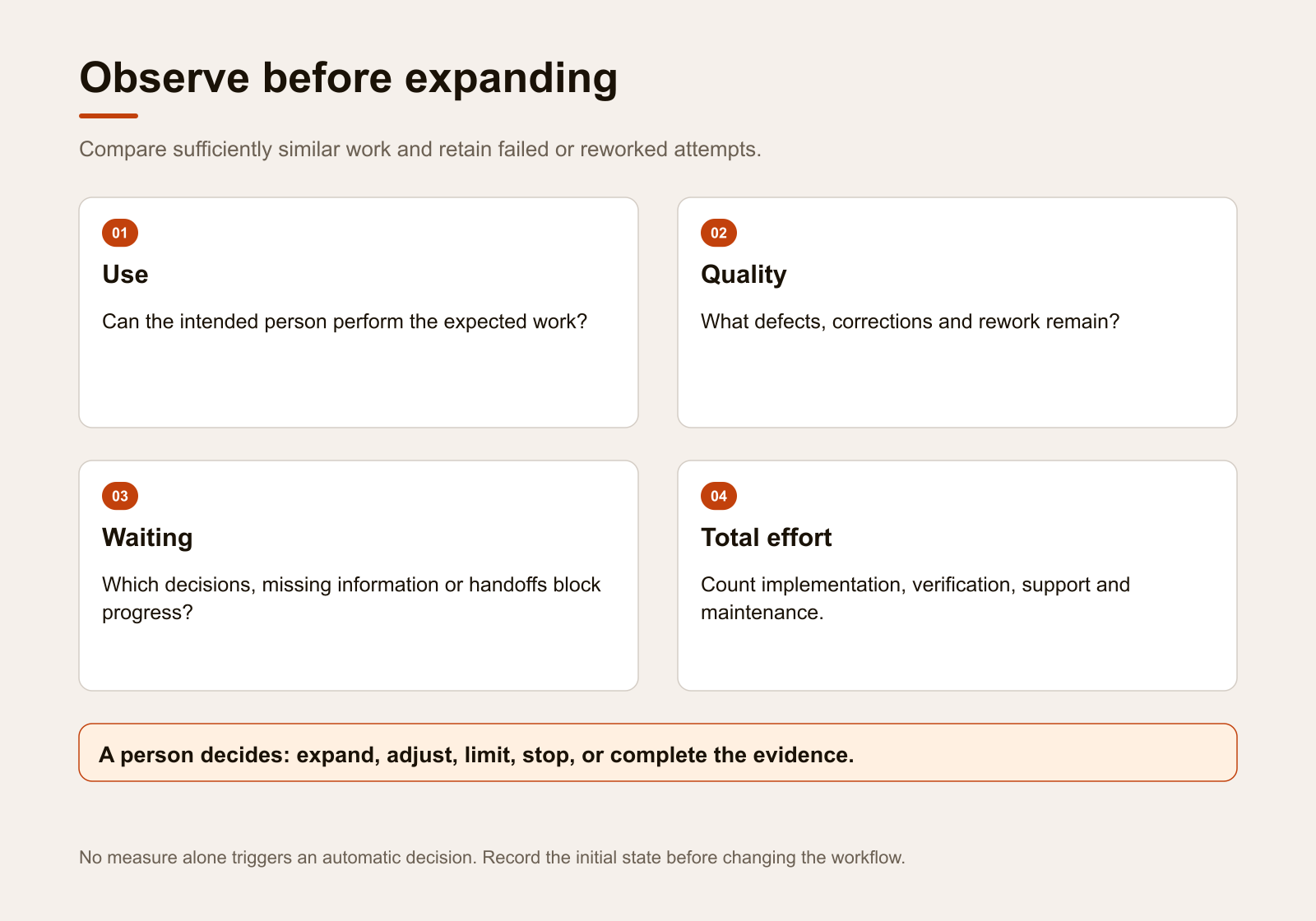
Observation prepares a decision; it does not replace its owner.
For coordination, I look particularly at waiting before a decision, searching for context and rework due to missing information. I retain preparation effort and the quality of the result received in the comparison.
Choose sufficiently comparable work, specify what is observed and retain rejected or reworked attempts. Faster production does not establish an end-to-end gain. When evidence is missing, complete it before expanding.
Before changing anything, record the initial state with the same observations planned afterwards. Each trial has a start, an end, a budget, an owner, someone who decides what happens next and a log retaining failed attempts. Without an end date, a pilot keeps stretching without producing a decision.
What can be observed without inventing a gain
Choose observations according to the problem
| Question | Possible observation |
|---|---|
| Does the result serve its beneficiary? | Use and ability to perform the intended work |
| Where does a decision or reception wait? | Blocked handoffs, expected answer and recipient capacity |
| What needed rework? | Defects, corrections and returns due to missing context |
| What effort was needed? | Implementation, verification, support and maintenance |
| What can the person do with less help? | Next trial, remaining difficulties and understanding of limits |
These observations describe the workflow and its difficulties. On their own, they do not justify ranking people. Without a reliable comparison, describe the available facts rather than attributing a percentage gain to them.
4 durations to distinguish, without combining them into a score
| Measure | What it describes |
|---|---|
| Useful feedback latency | Time until a result that enables action |
| Run duration | Time occupied by execution |
| Human attention | Preparation, explanation, supervision, examination and rework |
| Time to accepted work | Elapsed time, including queues |
The evaluation guide separates these durations. Cost per accepted task retains failed attempts and rework. These methods do not provide a gain measurement for this playbook.
In the historical export of my 5 reviewers, 392 of 8,728 inline comments received a visible human reply or resolution. The window runs from 28 June to 28 September 2026 in one repository. Silent fixes remain unknown; this rate measures neither usefulness nor correctness. Automatic resolution does not constitute a human decision.
A usage trace left in the history is a lower bound: people using AI without leaving it disappear from the count. Usage, accepted work and provenance remain 3 separate observations, never added together. A gain people report is a hypothesis to test, rather than a measurement.
Worksheets to use with the team
Choose the worksheet that helps address the current problem.
Complete these questions with the people doing the work and those receiving it. Keep useful fields, disagreements and unknown answers. A worksheet should clarify what happens next without adding unnecessary approval.
Worksheet: choose a use case
Worksheet: choose a use case
Observed situation:
Person or team concerned:
Current difficulty and example:
Expected useful result:
What we already know:
What we want to test:
Chosen scope and exclusions:
Person who will examine the result:
Person deciding what happens next:
Trial start, end and budget:
Initial state recorded and date:
Observation that would make us revise or stop the trial:
Worksheet: make waiting visible
Worksheet: make waiting visible
Work concerned:
Since which handoff has it been waiting?
Person or team waiting:
Missing decision, information or verification:
Person who can provide it:
Effect of waiting on subsequent work:
Work to defer or reduce:
Owner of deferred work and condition for resuming:
Next observation:
Worksheet: prepare a decision and handoff
Worksheet: prepare a decision and handoff
Work and expected useful result:
Exact decision to make:
Decision owner and people to consult:
What the team can decide within the agreed framework:
Available and missing information:
Decision, reason, reference and version/verification date:
People whose work changes and explanation to share:
Result handed over, current state and checks done:
Recipient, next action expected and confirmed reception:
Receiving capacity and any blockers:
Situation that would justify revisiting the decision:
Worksheet: share responsibilities
Worksheet: share responsibilities
Use case and scope:
Who owns the need?
Who contributes and with what access?
Who verifies what?
Who accepts, with what authority?
Which actions need additional agreement?
Who responds when someone is blocked?
Who maintains the rules and documents?
Which rules can the team add, and who decides to remove one?
Who takes over after outside support, and when is the handoff reviewed?
Worksheet: explain a trial to the team
Worksheet: explain a trial to the team
The problem we chose:
Why we are addressing it:
What changes for the people concerned:
What remains to decide:
Trial scope and limits:
How to ask for help or report a problem:
Who responds:
What we will observe:
How we will share what happens next:
Worksheet: organise learning
Worksheet: organise learning
Person or group concerned:
Work to learn and knowledge already present:
First trial and limits:
Practice time provided within the job:
Authorised tools, access and confirmed budget:
Person available to help:
Feedback to examine together:
Next trial agreed:
What the person continues to practise without assistance:
Worksheet: decide what happens next
Worksheet: decide what happens next
Use case and scope observed:
Expected result and beneficiary:
Initial state and observation date:
Available observations, including rejected or reworked attempts:
Situations compared, if any:
Feedback latency, run duration, human attention and time to acceptance:
Rework, waiting and support needed:
Costs included and costs still unknown:
Unverified effects:
Proposed decision and owner:
What will trigger a further review:
The podcast and further reading
Watch the episode of The CTO Playbook with Adam Horner, recorded on 3 November and published on 17 November 2026. The media page lists the audio platforms.
Further reading: follow work to a result people use, technical verification, shared team context and the full cost of accepted work.
Adam’s questions that extend this guide
| Question | Reference | Clarification in the guide |
|---|---|---|
| How do you maintain the harness over time? | 33:05 | Collect a difficulty, update the source and observe the next use |
| How do you scale within a team? | 33:18 | Communication, decisions and visible initiatives; still work in progress in my answer |
| What is shared and what is individual? | 45:54 | Separate the team harness from personal setup |
| Can you walk through the playbook? | 49:54 | The 6 steps; post-delivery observation developed in the guide |
| Return to the need when the plan reveals a problem? | 52:33 | Revisit framing before starting implementation |
| Improve the result or the way it is built? | 59:03 | Correct the work, then retain confirmed learning |
More reading from the portfolio
According to the question to explore
| Topic | Reading |
|---|---|
| Waiting and review | Coding faster moves the cost to verification |
| Supporting a business contribution | Augustin’s case |
| Experience and learning | From VP engineering to solo builder |
| Costs and value | Invisible ROI |
| Technical responsibilities | Context engineering: the new roles |
| Getting started with development | Where to start with Claude Code |
From a team problem to Claude Code Guide mechanisms
Explore a specific difficulty
| Team question | Technical detail |
|---|---|
| What information should we retain, and where is the current state? | Durable documentation, live sources and procedures |
| How do we hand over an executable decision? | Handoff contract and next owner |
| What if verification cannot keep up? | Admission according to verification capacity |
| Can a person actually supervise? | Capacity, usable evidence, pause and resume |
| What takes time? | 4 distinct durations |
| What is the cost of the accepted result? | Attempts, human examination and rework |
These chapters provide mechanisms and methods to test, rather than an already demonstrated collective result. Document-count thresholds and dated product capabilities on the knowledge page are not adopted as universal rules. Adapt source access to the team’s people, tools and rights.
Studies and accounts to test the playbook against
Share expertise across functions. P&G, 2026 publication: 791 participants analysed in a one-day workshop. Assisted proposals combine more R&D and commercial perspectives; sustained coordination remains to be examined.
Adapt support to experience. Generative AI at Work observes a staged rollout to 5,172 support agents, with different effects according to experience. The unit is resolved issues per hour in that context.
Retain judgement. CHI 2025 survey: 319 people describe 936 tasks. Responses inform verification and stewardship; they do not establish causal cognitive decline.
Evaluate the combination. 2024 meta-analysis, covering 106 experiments before July 2023: improving on the human alone and outperforming the better of human and AI are distinct comparisons. The results do not qualify a 2026 reviewer.
Separate perception and measured time. METR, 2025 experiment and February 2026 follow-up: keep the historical result tied to its participants and tools; the follow-up identifies selection and measurement biases.
Count automated verification. Tokenomics, found through Paper Insights: 30 ChatDev tasks, with 59.4% of tokens in automated review on average. This does not measure human review or team coordination.
YouTube Insights retrieves Andrew Ng, 02:04–03:33 on product, marketing, compliance and design constraints; uReview at Uber, 07:03 on bounded reviews adapted to teams; making tacit knowledge discoverable, 19:25. These are accounts from subtitles, without controlled comparisons in the selected passages.
These studies were added after recording. They help choose what to test; none measures the playbook’s gain at Aristote or clients. The working dossier retains queries, versions, data references and coverage limits.
Sources, limits and clarifications after recording
The timestamps follow the published edit and Adam’s questions are paraphrased. The review blocker comes from the preparation material, drawing on the Aristote manual 2.3 and the harness dossier dated 22 October. Augustin’s account describes his work at Aristote.
After the recording, I added practices from client engagements, including revisable decisions, handoff requirements and trial design. I propose testing them in each organisation with a baseline and a decision at the end.
Glossary
Acceptance: An authorised person’s decision to use or deliver a result, based on criteria and evidence examined.
CAIO: Chief AI Officer. In this guide, the role through which Florian connects use-case choices, work organisation, support and observation of results.
Collective efficiency: In this guide, examining the means and effort needed for useful work to be accepted and used, including waiting and rework between people.
Harness: Context, procedures, tools and checks framing work with AI. Shared elements are separate from workstation preferences.
Handoff: Passing work to another person with context, the result’s current state and the action expected so they can take it over.
Next trial
For the next trial, name a pending decision, the missing information, the person receiving the work and the person taking over the system. Observing that handoff helps decide what to change next.
Dated sources
-
Lean AI: work that reaches users · local version reviewed · 2026-10-15
-
Coding faster moves the cost to verification · local version reviewed · 2026-10-15
-
From code to merge · Dev With AI talk guide · 2026-10-15
-
The AI instruction system as a product · local version reviewed · 2026-10-24
-
Augustin’s case · a situated account, no promised duration · 2026-10-01
-
From VP engineering to solo builder · local version reviewed · 2026-10-23
-
Invisible ROI · local version reviewed · 2026-10-01
-
AI FinOps · local version reviewed · 2026-10-15
-
Context engineering: the new roles · local version reviewed · 2026-10-01
-
Where to start with Claude Code · reading path · 2026-10-01
-
Turn recurring review comments into tested controls · 2026-11-03
-
5 reviewers : historical export, visible responses · 2026-10-14
-
Portable agent configuration : source, distribution and behaviour · 2026-10-11
-
Claude Code Guide : team knowledge, local version consulted · 2026-11-03
-
Claude Code Guide : responsibilities and controls, local version consulted · 2026-11-03
-
Claude Code Guide : handoff contract, local version consulted · 2026-11-03
-
The Cybernetic Teammate: A Field Experiment on Generative AI and Teamwork · 2026-06-12
-
Generative AI at Work · 2025-02-04
-
Measuring the Impact of Early-2025 AI on Experienced Open-Source Developer Productivity · 2025-07-10
-
Tokenomics: Quantifying Where Tokens Are Used in Agentic Software Engineering · 2026-01-20
-
When combinations of humans and AI are useful: A systematic review and meta-analysis · author text v2 · 2024-10-29
-
METR : methodological update · 2026-02-24
-
The Future of AI Agents with Andrew Ng | Interrupt 26 · 2026-06-17
-
Building uReview, Uber’s Multi-Agent Code Review Engine · 2026-08-28
-
A Developer’s Guide to Not Getting Replaced by Agents · 2026-03-10
Go Further in the Claude Code Guide
Practical resources selected to help you take the next step.