Campus IA in Fouju: the project in brief
Near Melun in Seine-et-Marne, Campus IA plans 11 data centers. The Élysée calls it France's largest AI campus. Three buildings are authorized.
Jump to summary ↓ Florian Bruniaux
Campus IA plans eleven data-center buildings in Fouju, in Seine-et-Marne. The buildings would contain servers, their electrical supply, and cooling systems to provide computing capacity, including for artificial-intelligence services. Here, “campus” means an industrial site rather than a school or university.
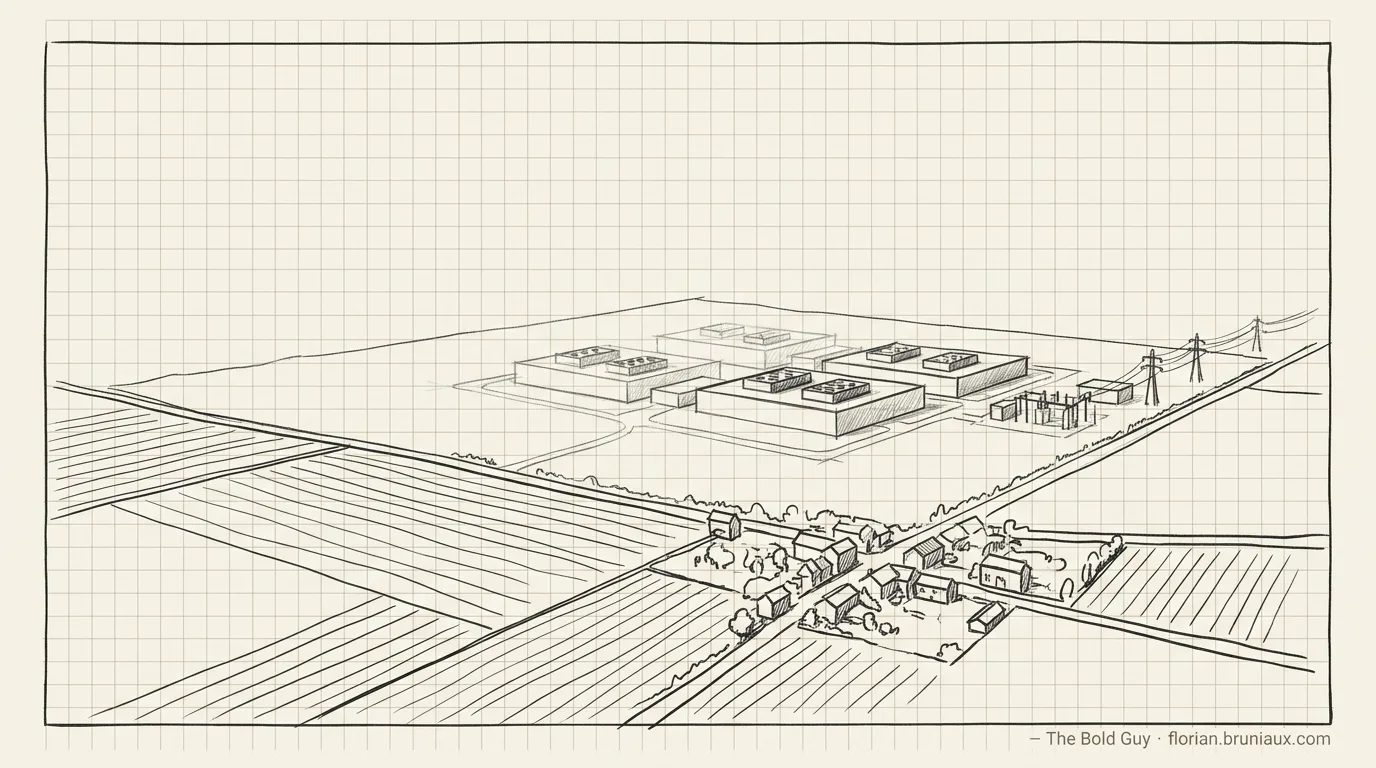
Campus IA is the name of the project. Campus AI is the company behind it. Its participants are MGX, Bpifrance, Mistral AI, and NVIDIA. Fouju has 655 residents and lies southeast of Paris.
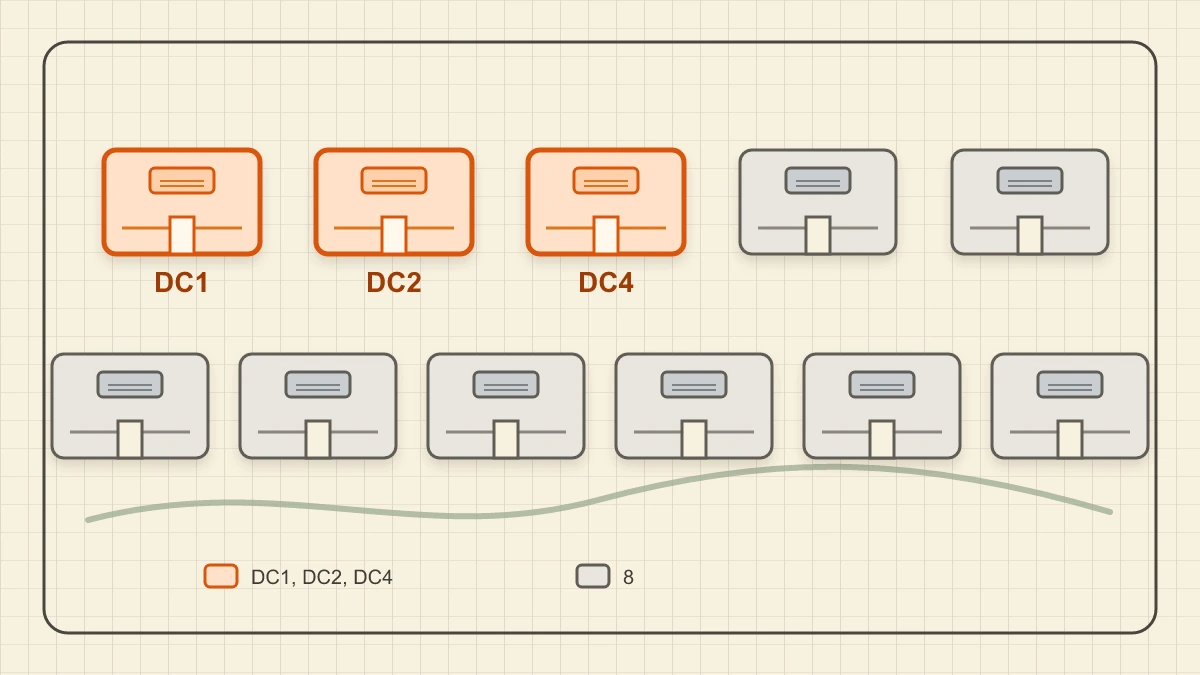
On July 29, 2026, the Seine-et-Marne prefect authorized DC1, DC2, and DC4. These names identify three buildings in the same project. None is operating yet. On August 28, the municipality announced the start of phase-one construction, beginning with site fencing, biodiversity-protection measures, and continuing archaeological work.
TL;DR
I support the development of data centers in France, and I favor the Campus IA project in Fouju itself, all eleven buildings, on one condition: strict regulation, monitoring over time, and published operating measurements (electricity, water, noise, refrigerant leakage, jobs, tax revenue). Those measurements do not exist yet: the public record contains only authorizations (three buildings out of eleven), developer commitments, and estimates, none of which is an operating result. My final judgment will depend on the first measurements published after commissioning. The conditions and their reasoning are set out in my position on the project. I work in AI, and part of my professional activity directly depends on the infrastructure examined here.
The project today
The environmental filing covers the complete campus. The July 2026 decisions authorize only DC1, DC2, and DC4 to operate their regulated installations. The remaining eight buildings will require separate decisions. Authorization does not mean a building has been constructed or entered service.
The documents use several schedules. The impact assessment separates three construction periods, while RTE describes two grid-connection steps. Prefectural decisions follow another sequence, one building at a time. Treating all three as a single “phase” would misstate the project’s status.
Size, power, and electricity use
| Topic | Figure or commitment | What the record establishes |
|---|---|---|
| Site | Roughly 90 hectares and 11 buildings | Planned full-campus design |
| Computing | 848 MW IT | Equipment assessed in the environmental filing |
| Grid | Up to 1.4 GW | Maximum connection planned with RTE |
| Electricity | More than 10 TWh per year at full scale | Forecast, not metered use |
| Investment | Up to €50 billion; about €8 billion to €8.5 billion for phase one | Announcement and public-file estimates |
| Current authorization | DC1, DC2, and DC4 | Three buildings, not the complete campus |
| Employment | 500 direct and more than 1,000 indirect jobs at full development; about 1,000 people during construction | Government estimates, not audited outcomes |
The 848 MW of IT equipment and the 1.4 GW maximum grid connection measure different things. The first figure covers servers assessed in the environmental filing. The second sets a connection ceiling for the site and its supporting systems. Neither is observed electricity use.
Electricity, water, biodiversity, and local impacts
Electricity and carbon
The filing forecasts more than 10 TWh of annual electricity use at full scale. The impact assessment estimates 38.3 million tonnes of CO2 equivalent over 50 years, an arithmetic mean of 0.766 million tonnes per year, with 63% attributed to electricity. The regional environmental authority asks for a broader accounting boundary. These are scenario estimates. Actual consumption, load profile, electricity mix, and carbon intensity will only become observable through operating data.
Water and cooling
Campus AI commits to dry, air-based cooling for phase one and no operational withdrawal from the Champigny aquifer. Dry cooling reduces one direct water pathway, but it does not prove a zero water footprint for construction, electricity generation, maintenance, or later phases. The commitment needs to be checked against the final design and measured withdrawals.
An analysis published by Benoît Petit for Hubblo on August 27, 2026 provides the accounting boundary needed to interpret that commitment. Under the life-cycle-assessment framework it describes, the article distinguishes water withdrawal, water returned to the same watershed, and water consumed, usually through evaporation in the case of cooling. It also separates on-site consumption from water linked to electricity generation and to construction and equipment manufacturing. The WUE(site) metric often reported by operators covers only local consumption per unit of IT electricity. Hubblo does not estimate Fouju’s future consumption: its framework shows why dry cooling alone cannot establish the campus’s complete water footprint.
Biodiversity
The inventory cited by the regional environmental authority records 61 bird species, two protected amphibian species, nine protected bat species, and 140 plant species. The record documents the initial survey and planned mitigation. It cannot yet establish whether those measures will protect populations and habitats after construction.
Refrigerant, noise, and air quality
The design inventories 514.3 tonnes of R-1234ze refrigerant and models about 15 tonnes of annual leakage under a 3% assumption. Degradation to TFA remains a possible pathway: no local contamination or health effect caused by the campus has been measured. Noise and emissions from backup generators also depend on tests and operating conditions that do not yet exist as public results.
Waste heat, jobs, and local effects
Waste-heat recovery
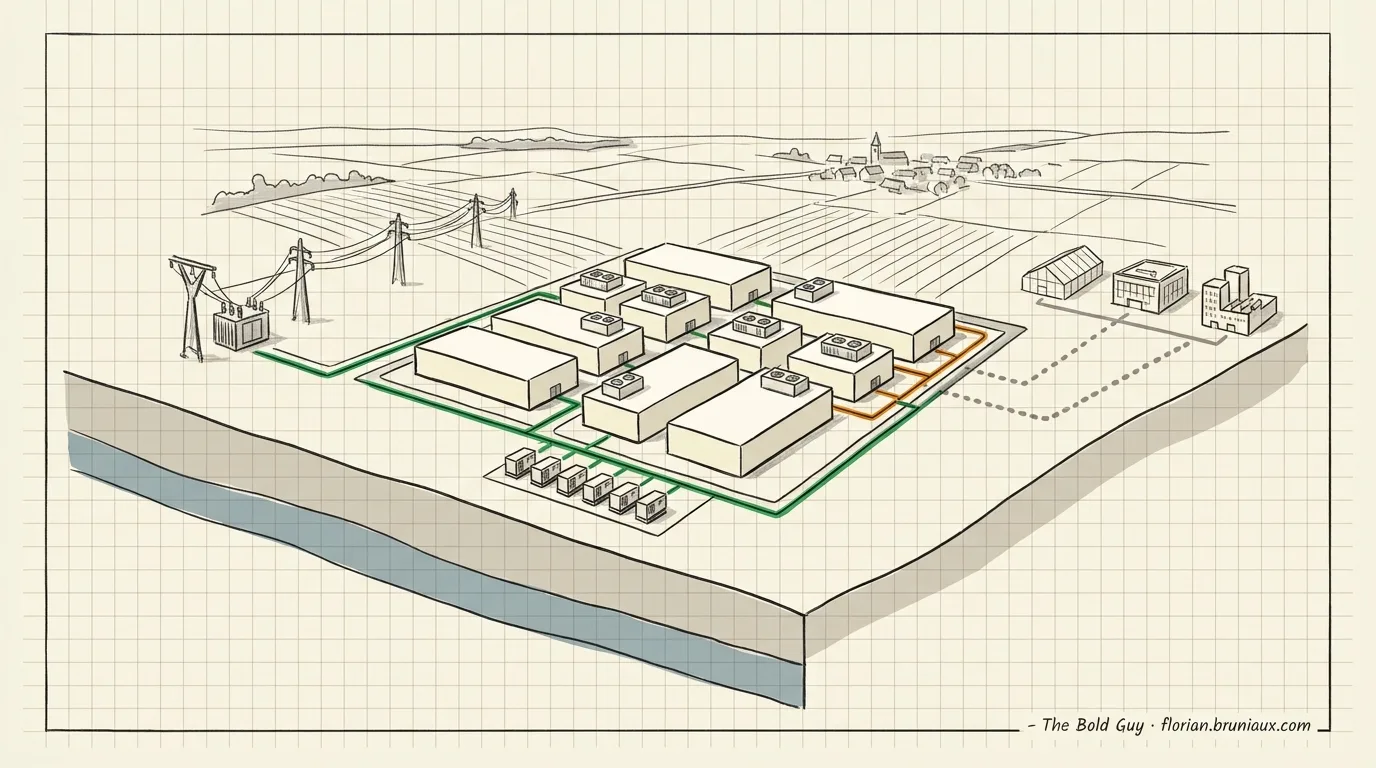
French law and the project documents frame waste-heat recovery as an objective, but useful delivery requires identified customers, a network, contracts, and viable temperatures. The public record does not yet establish delivered heat.
Jobs and local economic effects
Employment and local-economic figures are projections. Audited outcomes would need to separate phase, occupation, residence, duration, procurement, tax revenue, and other local spending.
What is established and what is missing
The documents do not all provide the same kind of information. An administrative authorization, a developer commitment, an estimate, and an operating measurement support different conclusions.
| Status | What it means | What it does not mean |
|---|---|---|
| Authorization granted | An item appears in an administrative decision. | It is already built or operating. |
| Developer commitment | Campus AI or RTE describes a future design or action. | The result has been verified in operation. |
| Modelled estimate | A calculation applies assumptions to a future scenario. | The value has been measured on site. |
| Information unavailable | The data is not yet public or measurable. | The eventual result is positive or negative. |
Before the campus operates, the public record cannot yet establish:
- annual metered electricity use or hourly carbon intensity;
- final direct and indirect water consumption;
- measured refrigerant leakage, TFA deposition, or local health effects;
- biodiversity outcomes after the planned mitigation measures;
- delivered waste heat or contracted customers;
- audited employment, procurement origin, or local spending;
- tax receipts retained by each local authority;
- the final distribution of grid costs.
The primary records are the prefectural decisions, the April 2026 opinion of the regional environmental authority, the public-inquiry register, the CNDP consultation archive, and RTE’s connection announcement.
The Campus IA source dossier contains the detailed analysis, stakeholder positions, sources, and open questions. I will update it when new decisions or operating data become public.