Engineering the Review Loop
Measure where delivery waits, bound AI review loops, gate merges on current evidence, and evaluate reviewers before ranking them.
Related: From code to merge: the illustrated Dev With AI talk guide.
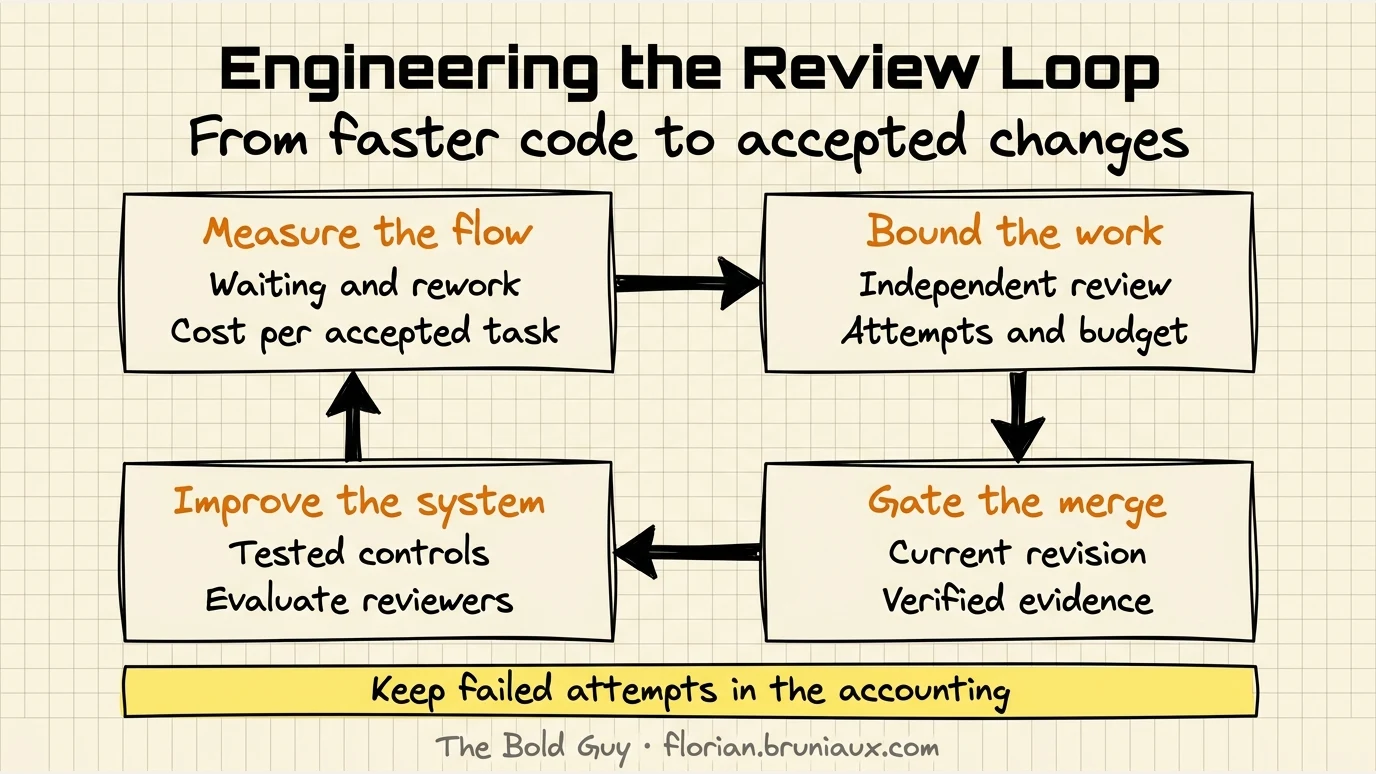
Measure the flow, bound review attempts, verify the current revision, then test improvements. This is the workflow to evaluate; the cycle does not establish an automatic learning system or a measured gain.
Open full-size infographic- 1
Coding faster moves the cost to verification
AI can shorten implementation while specification, review, CI, and rework absorb the saved time. Instrument the full flow before adding more generation.
Article · - 2
When an independent reviewer earns its place
Compare independent review with self-review and deterministic checks. Measure rescued defects, false acceptances, regressions and the cost of another pass.
Article · - 3
Designing a bounded review loop
Build a bounded review loop with frozen inputs, separate execution and outcome fields, retry limits, evidence handoffs and human escalation.
Guide · - 4
A green review is not a merge gate
A review signal matters only when its provider, commit SHA, coverage, execution state, publication, and place in branch policy are explicit.
Article · - 5
Turn recurring review comments into tested controls
When the same accepted correction returns, test whether it belongs in a linter, type, test, example, repository rule, checklist, or architecture decision.
Article · - 6
Operating a multi-reviewer system safely
Run local, CLI, and remote reviewers with explicit trust boundaries, least privilege, structured findings, budgets, degraded states, and shutdown controls.
Guide · - 7
5 AI code reviewers, 1 repository, and what developers did next
Three months, 1,011 pull requests and 8,728 inline AI review comments: 4.5% got a visible human response. What the data shows, and what it cannot.
Article · - 8
Testing Opus 5.5 as the code-review baseline
Opus 5.5 is the next reviewer baseline to test: set effort explicitly, update the API adapter, and keep a second reviewer only when it catches verified defects.
Article ·